
Kalkaska County Circuit Court Overview
In Michigan, the circuit court is the state's main trial court of general jurisdiction. It hears felony criminal cases, civil suits that ask for more than $25,000, divorce, and other family matters. It also reviews appeals that come up from the district court and from many state agencies. Kalkaska County falls under the 46th Circuit, and the local bench handles the serious cases that a lower court cannot resolve on its own.
What makes Kalkaska different is that the courts do not stand apart in separate buildings. The circuit court, the 87-B District Court, the Probate Court, and the Family Division all run as one unified 46th Circuit Trial Court at 605 North Birch Street. This shared campus means the same front counter, calendar, and staff often serve more than one division. The county clerk acts as the clerk for the 46th Circuit Court, while the district and probate sides keep their own administration and dockets.
Michigan's court ladder is short and clear. Trial courts sit at the base, the Michigan Court of Appeals sits above them, and the Michigan Supreme Court sits at the top. A helpful map of that structure appears on the Michigan courts overview page, which lays out how the circuit, district, and probate courts fit together.
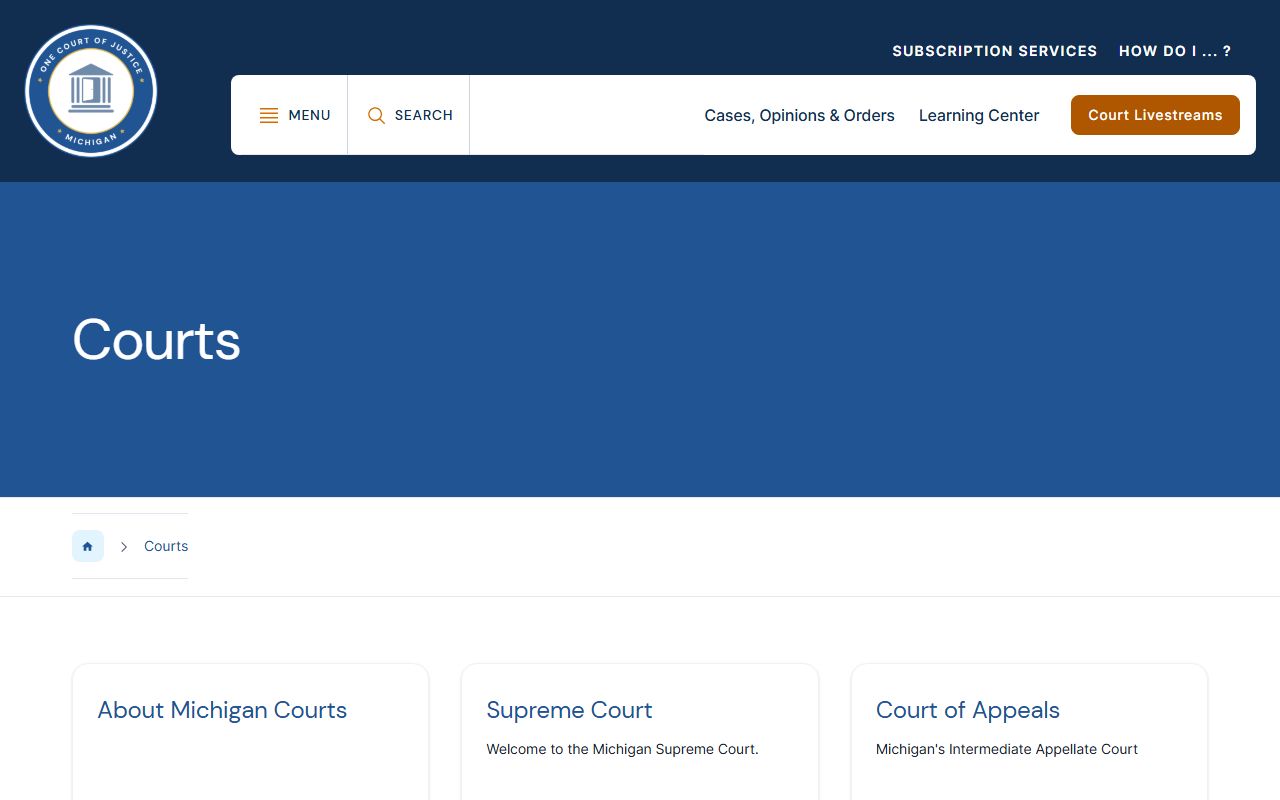
That statewide picture is the frame for the local one. In practice, a Kalkaska resident deals with the trial-court layer first, and only reaches the Court of Appeals if a judgment is challenged.
Divisions of the Kalkaska County Trial Court
Instead of numbered courtrooms, Kalkaska County groups its work into divisions under the unified trial court. Each division has its own phone line, fax, and staff, even though they sit on the same campus. The table below lists the main court offices and how to reach them. These numbers come straight from the county court contacts, so they route your call to the right desk on the first try.
| Division / Office | Handles | Phone | Fax |
|---|---|---|---|
| 46th Circuit Court | Felonies, major civil over $25,000, divorce, family-law appeals | 231-258-3349 | 231-258-3337 |
| 87-B District Court | Misdemeanors, civil infractions, small claims, general civil under $25,000, early felony stages | 231-258-9031 | 231-258-2424 |
| Probate Court | Estates, guardianship, conservatorship, mental-health matters | 231-258-3330 | 231-258-2424 |
| Family Division | Juvenile, adoption, name changes, custody and support | 231-258-3314 | 231-258-2424 |
| Friend of the Court | Support, custody, and parenting-time enforcement | 231-258-9744 | 231-258-0129 |
| Court Administrator | Administrative contact for the trial court | 231-258-3330 | 231-258-2424 |
The circuit clerk line is shared with the county clerk, since one office serves both roles. If you are not sure which desk you need, the district or administrator line can point you the right way. Court offices keep hours of 8:00 a.m. to 4:30 p.m., Monday through Friday.
Circuit Court vs District Court vs Probate Court
The three main trial courts in Kalkaska County do not overlap much. Each one owns a clear slice of the caseload, set by the type of dispute and the dollars at stake. The chart below shows the split so you can tell where a case belongs before you file. This matters because filing in the wrong court can delay a case or send you back to the counter to start over.
| Circuit Court | District Court | Probate Court | |
|---|---|---|---|
| Main case types | Felonies, major civil, divorce, appeals | Misdemeanors, traffic, small claims | Estates, guardianship, mental health |
| Civil dollar limit | Over $25,000 | Up to $25,000 | Estate and trust value |
| Criminal reach | Felony trials | Misdemeanors and early felony stages | None |
| Family and probate | Divorce and family appeals | Limited | Wills, trusts, conservatorship |
A felony always touches both the district and circuit sides. The case opens in district court for the early hearings, then moves up to circuit if the judge finds enough proof to bind it over. Probate stands apart, focused on estates and the care of people who cannot manage their own affairs.
How a Case Moves Through the Kalkaska County Courts
A criminal case does not jump straight to trial. It moves through a set order of steps, and each step has its own court date and paperwork. The flow starts with an arrest or a charge filing and ends, if needed, at the state appellate level. Civil and family cases follow a similar path, but they open with a petition instead of an arrest.
Case flow: Arrest or Filing › District Court / Magistrate › Bindover or Circuit Court › Pretrial › Trial › Sentencing or Judgment › Court of Appeals
Felony matters begin in the 87-B District Court, where a magistrate handles the first appearance, sets bond, and holds the preliminary exam. If the case is bound over, it moves to the 46th Circuit Court for arraignment on the information, pretrial conferences, and any trial. After a verdict or plea, the judge sets a sentence or enters a judgment. A party who disagrees can then ask the Michigan Court of Appeals to review the result.
Misdemeanor and civil-infraction cases usually stay in the district court from start to finish. They do not get bound over, so they resolve at the lower level unless a party appeals.
Family cases run on a track of their own. A divorce opens with a complaint, followed by an answer, discovery, and often mediation before a trial or a settled judgment. When minor children are involved, the Friend of the Court joins the case to help set support and parenting time, and its orders can be enforced long after the judgment is signed.
Where to File in Kalkaska County
Because the courts share a campus, the biggest question is not where to drive but which division to name. The county publishes a routing guide that maps common matters to the right court. That guide is the fastest way to avoid a wrong turn, and it covers the everyday filings that residents bring in most often.
- Felonies: district court first, then circuit court after bindover.
- Misdemeanors, traffic, and parking infractions: district court.
- General civil under $25,000: district court; over $25,000: circuit court.
- Divorce and family-law matters: circuit court and the Family Division.
- Name changes, juvenile, and adoption: Family Division.
- Guardianships, conservatorships, estates, and wills: Probate Court.
- Personal protection order (PPO) filings: county clerk.
The Family Division handles some of the most sensitive files in the county, from juvenile delinquency to child protection and adoption. Its work sits close to the circuit court because divorce and custody often overlap. The court's own family-matters page lays out these case types in plain terms.
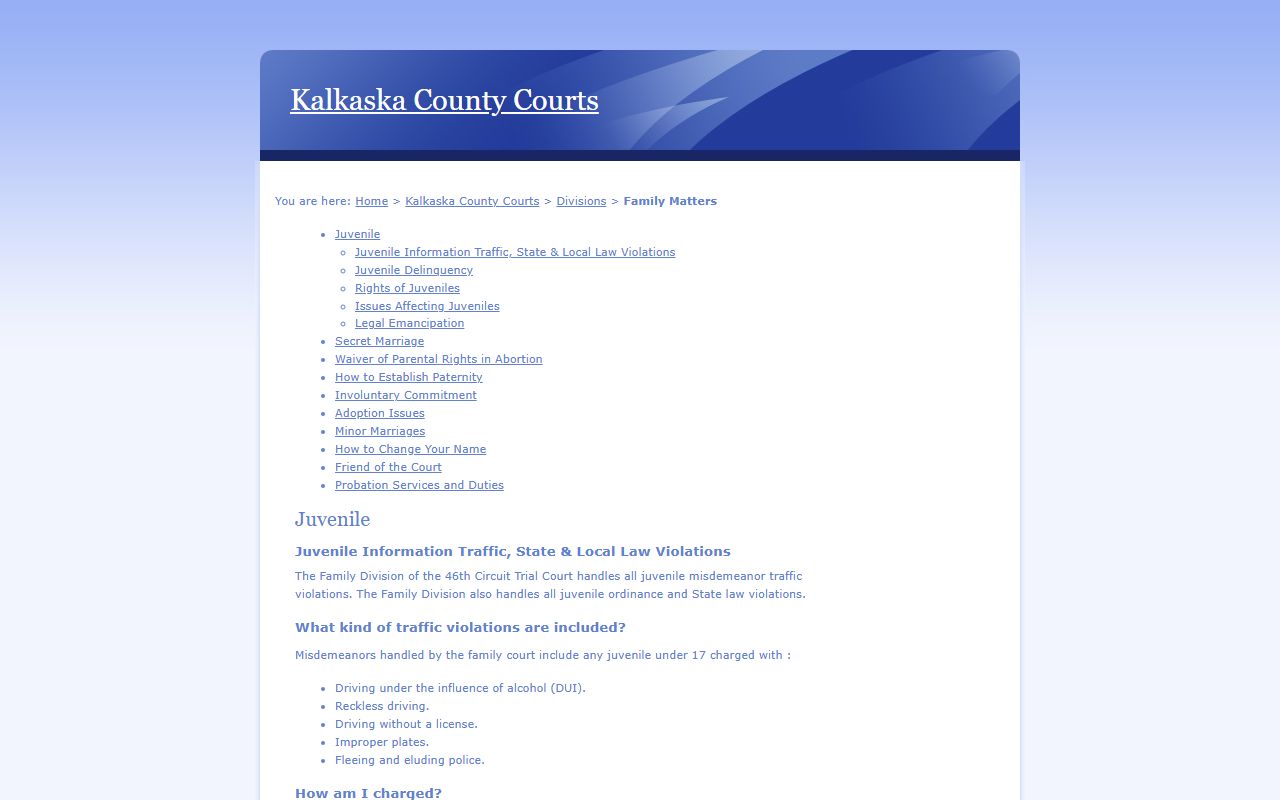
Reading that guide before you file helps you name the right division and attach the right forms. When a divorce involves minor children, the Friend of the Court steps in on support and parenting time.
Judges of the Kalkaska County Circuit Court
A small county bench means a handful of judges carry the full docket across divisions. In Kalkaska County, the same judges often preside over more than one court, which keeps the unified trial court running with a lean staff. Their names appear on orders, judgments, and hearing notices, so it helps to know who sits where.
The Honorable Janet M. Allen serves as the 46th Circuit Court Chief Judge and leads the circuit bench. The Honorable George J. Mertz sits as a Circuit Judge on felony and major civil matters. The Honorable Lynne M. Buday serves as the Chief Probate and District Judge, covering the probate and district sides of the campus. Judge biographies and division notes are posted on the court's judge biography page.
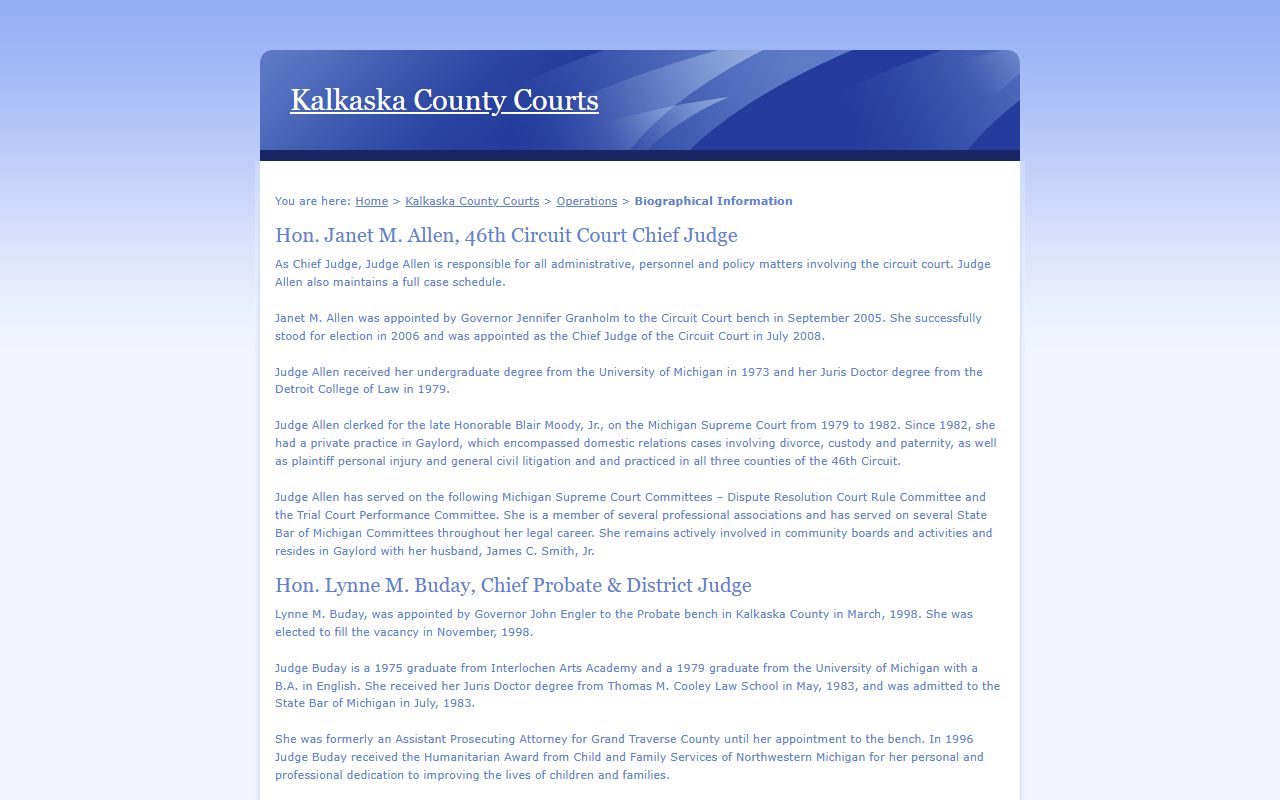
Because judges cross divisions, a single case can list more than one judge over its life. A felony that starts in district court and moves to circuit may see a district judge at the exam and a circuit judge at trial.
Note: The court also assigns magistrates and probation officers who handle bond, arraignment, and screening tasks under a judge's authority.
Searching Kalkaska County Circuit Court Records
The county's main public tool is the 87-B District Court case search and payment portal. It is name-driven, so you type a last name, click to display, and open a case number to see the detail or make a payment. New tickets can lag by up to five days, and any bond already posted should be subtracted before you pay. The portal is a convenience tool, not the full official record, and it does not cover every circuit matter.
For older files, sealed matters, or anything not visible online, the clerk's office is the fallback. The county clerk keeps records back to 1871 and helps with certified copies and research by mail or in person. Deeper record detail, hearing dates, and the difference between the portal and the official file are covered on the Kalkaska County court records pages. A separate combined calendar lists hearing dates for circuit, district, and probate matters, but it is informational only and does not replace the official docket.
Note: The court warns that some records are nonpublic and that online information is offered without a warranty as to accuracy, so verify anything important with the clerk.
Federal Court for Kalkaska County
State courts are only half the picture. Federal crimes, civil-rights suits, bankruptcy, and federal civil cases do not go through the circuit court at all. For those matters, Kalkaska County sits inside the Western District of Michigan, a separate federal system with its own judges and rules. The county has no federal courthouse of its own, so filings and hearings happen at the district's staffed locations.
The Western District runs courthouses in Grand Rapids, Lansing, Kalamazoo, and Marquette. A public page confirms that Kalkaska is one of the counties the district covers. That county list appears on the Western District of Michigan counties page, which is the quickest way to confirm where a federal case would be filed.
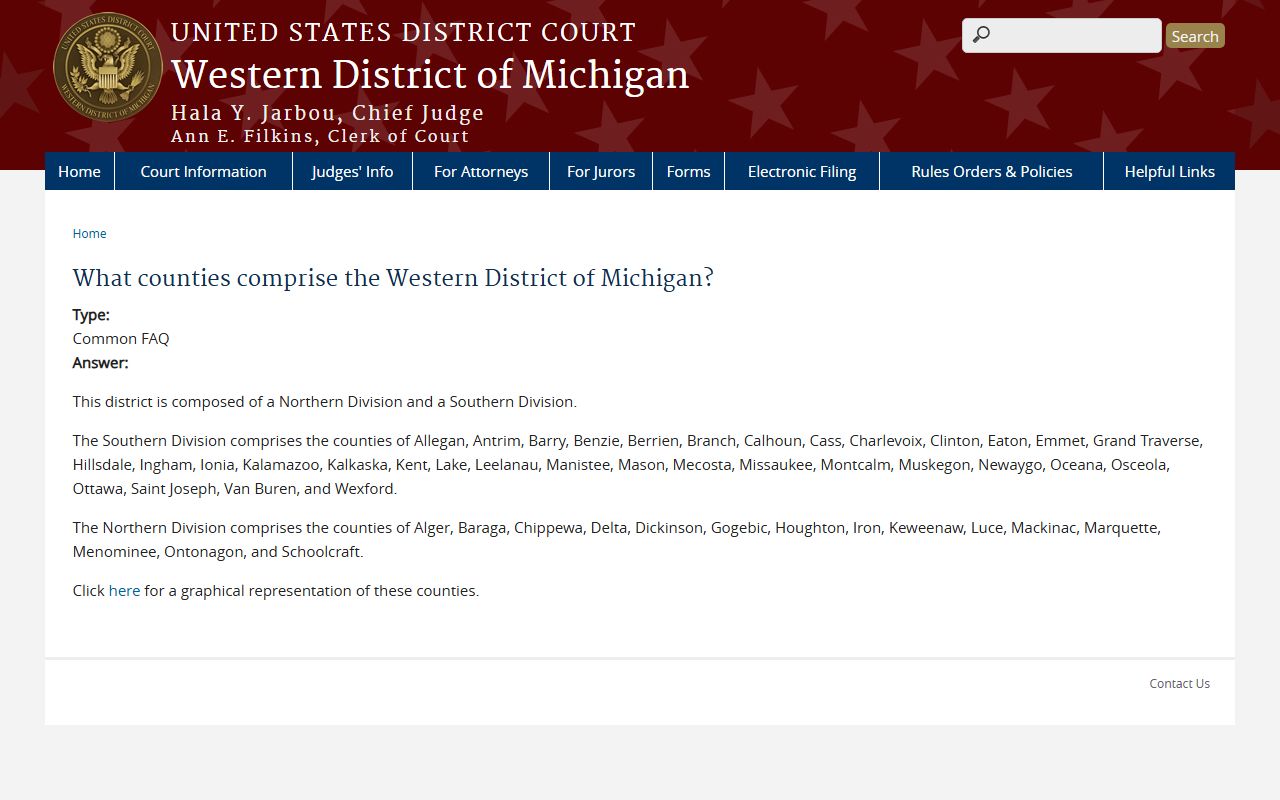
Keeping the two systems apart avoids confusion. A state felony stays in the circuit court, while a federal charge routes to the Western District. Appeals from the federal side go to the Sixth Circuit, not the Michigan Court of Appeals.