
Kalkaska County Arrest Records and Court Charges
An arrest record is the account of the arrest itself. It notes who was taken into custody, which agency made the arrest, and the booking that follows at the jail. In Kalkaska County the sheriff runs booking, where staff fingerprint and photograph each person and log basic details. That intake step is the arrest side. It does not by itself decide guilt, and it does not set the formal charges. The charge decision comes next, and it belongs to the prosecutor, not the arresting officer.
The court charge record is a separate file. After an arrest, the Kalkaska County prosecutor reviews the police reports and decides which charges to bring. Those charges are filed with the court clerk and tracked through the case. The booking side lives with the jail, so the Kalkaska County inmate records page is the place for the roster and booking detail. The full case file, with pleas, disposition, and sentence, sits with the criminal court records.
How to Find Kalkaska County Arrest Records and Charges
Charges show up in the court case record, so the main tool is the 87-B District Court case search and payment portal. The portal is name driven and simple to use. Enter a name, run the search, and open the case to read the charge list. The arrest and booking detail is not on this portal. That side is handled by the sheriff and the jail, and Kalkaska inmates are currently housed in Wexford County, so there is no county roster portal for booking photos. For anything custody related, the inmate records page points to the right contacts.
- Open the 87-B District Court case search portal.
- Type the last name or business name, and add a first name to narrow the results.
- Click OK - Display, then click the case number to open the case.
- Read the charge table for the count, the charge, the adjudication date, and the judgment.
The Kalkaska district clerks are the staff who key these cases in. Their duties give a clear picture of how a charge becomes a searchable record. The district division clerk job description lists civil, criminal, and traffic case processing among the office tasks.
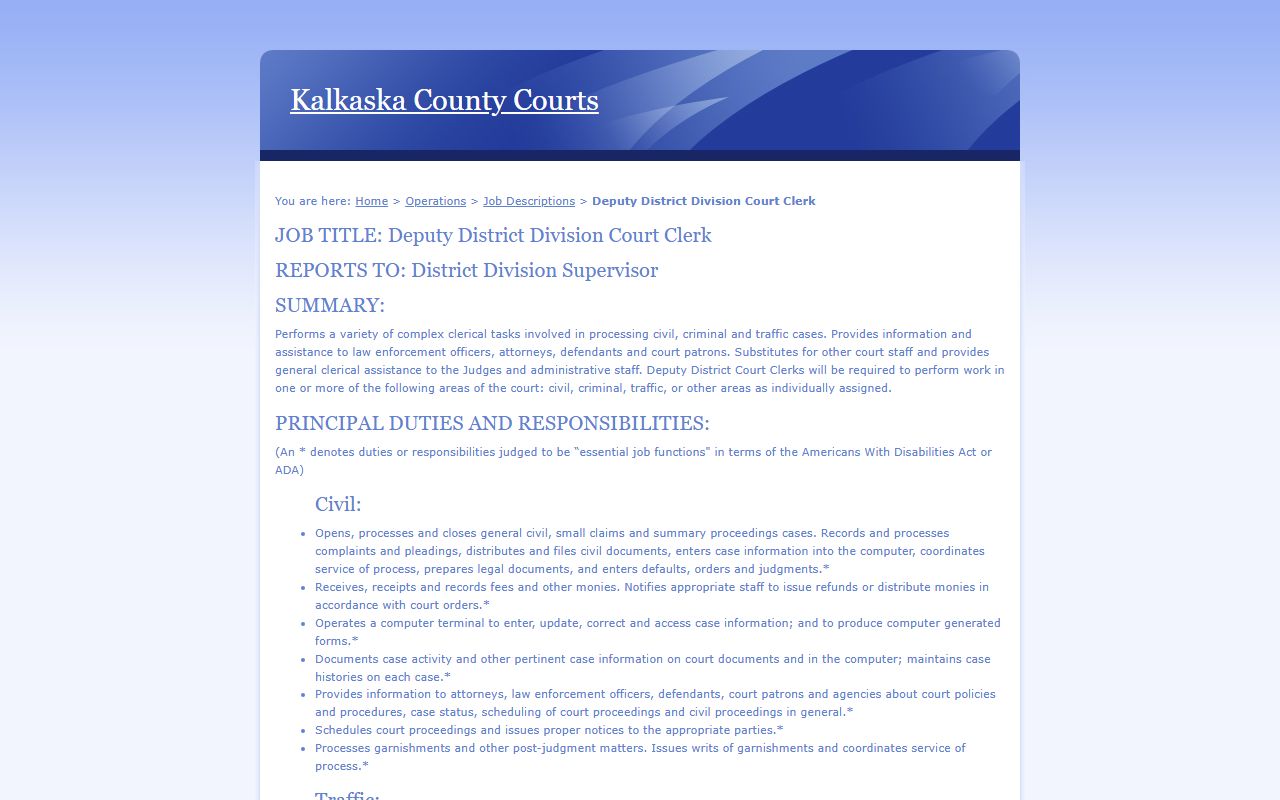
That job description matters because it shows the clerk enters and maintains the charge data that the public later searches. Newly received tickets can lag by up to five days before they appear, and a posted bond should be subtracted before any payment. For records not visible online, the county clerk office and a FOIA request are the fallbacks. Statewide, the MiCOURT case search reaches many Michigan trial courts and can help when a case name is common.
How Charges Get Filed After an Arrest
The path runs from arrest to a filed charge. The arrest and booking happen first, then the charge record begins when the prosecutor files a charging document with the court. Michigan uses three main forms. A complaint and warrant open most cases, an information carries a felony forward after the district court finds enough proof, and a grand jury indictment is used only rarely. Each one starts a case, but the route and the seriousness differ.
| Complaint | Information | Indictment | |
|---|---|---|---|
| Filed By | Officer / Prosecutor | Prosecutor | Grand Jury |
| Common For | Misdemeanors and early felonies | Felonies after bindover | Serious felonies (rare) |
| Starts | The case | The circuit case | The case |
In Kalkaska, misdemeanors stay in the 87-B District Court, while felonies begin in district court and move to circuit court after bindover. The bindover step is where a felony complaint gives way to an information. Because the local system is unified under the 46th Circuit Trial Court, the same courthouse handles the whole path.
The Kalkaska County Prosecutor and Filing Charges
Charges are the prosecutor's call. The Kalkaska County Prosecuting Attorney is Ryan Ziegler, whose office sits at 605 North Birch Street in Kalkaska. Police make the arrest and write the reports, but the prosecutor decides which charges to file, whether to add or drop counts, and how to word each charge. That choice controls what shows up in the court charge record.
The office handles the county's criminal prosecution work. It also takes part in paternity and child support establishment before those matters move to the Friend of the Court. Because one office drives the charging decision, a single arrest can lead to more counts, fewer counts, or a different charge than the one an officer first named at booking.
Note: The charge listed at booking is not final, since the prosecutor can change it before or after the case is filed with the court.
Charge Codes and Severity Levels in Kalkaska County
Every charge points to a statute, and each statute sets a severity level. Michigan sorts criminal matters into felonies, misdemeanors, and civil infractions. Felonies are the most serious and can bring prison time. Misdemeanors are lower level and are heard in the district court. Civil infractions, such as many traffic tickets, are not crimes at all and carry fines rather than jail.
One arrest can produce several separate charges. A single incident might list a felony count, a misdemeanor count, and a civil infraction on the same case. Each count carries its own code, level, and status, so a case can end with a mix of results. The record keeps every count as its own line, which is why one case number can show more than one charge and more than one outcome.
Charge Status and What It Means
Charges rarely sit still. As a case moves, a charge can be amended, reduced, added, dropped, or dismissed. The status field is how the record tracks those shifts. A charge that was serious at filing may end up reduced, and a charge that once looked firm may be dismissed before trial. The terms below appear across Kalkaska court records and Michigan case files.
| Status | What It Means |
|---|---|
| Pending | The charge is filed and the case is still open, with no final outcome yet. |
| Amended / Reduced | The prosecutor changed the charge, often to a lower level or a different count. |
| Dismissed | The court ended the charge, and it is not pursued further. |
| Nolle Prosequi | The prosecutor formally chose not to pursue the charge. |
Status matters because it tells you where a charge stands, not just what it started as. A dismissed or nolle prosequi charge is not a conviction. It stays in the record as a filed charge with a closing note, which is why the status line and the judgment line both deserve a careful read.
What a Kalkaska County Charge Record Shows
A charge record is more than a single charge line. The district case detail page pulls together the parties, the money owed, and the outcome for each count. The sample district record shows how these pieces fit, with a clickable case number tied to real case data rather than a static list. The fields below are the ones a reader actually sees.
- Case Number
- The court identifier for the case, such as 2326772SM2.
- Party Name
- The named defendant on the case.
- Charge Table
- Each count with its charge, adjudication date, and judgment.
- Amounts
- Amount assessed, amount paid, balance due, and last payment.
- Jail and Probation Terms
- Any jail term and probation term in years, months, and days.
- Comment
- Case notes, such as a line that assessed amounts do not include restitution.
A real example makes it concrete. The sample record lists a charge of Domestic Violence with an adjudication date of June 7, 2023 and a judgment of Dismissed. That single line shows the pattern. The charge was filed, the case was adjudicated on a set date, and the judgment closed the count. Case numbers are not uniform across systems, so a district number like 2326772SM2 will not match the format used in state prison data.
Charges vs. Convictions
Being charged is not the same as being convicted. A charge is an accusation that the prosecutor files. A conviction is the finding of guilt that comes from a plea or a verdict. The Domestic Violence example above ended in a dismissal, so it is a charge on the record but not a conviction. The table sets the two side by side.
| Charge | Conviction | |
|---|---|---|
| Stage | Accusation at filing | Verdict or plea |
| Burden of Proof | Probable cause | Beyond a reasonable doubt |
| Meaning | Case is charged, outcome open | Guilt is established |
| Public Record | Yes | Yes |
Both a charge and a conviction can appear in the public record, which is why the judgment line matters so much. A charge with a dismissal or a not guilty result should never be read as a conviction. Readers need to check the outcome, not just the fact that a charge was once filed.
Statewide Charge and Criminal History Lookups
Local charges can roll up into statewide tools. The MiCOURT case search reaches participating Michigan trial courts, so it is a useful second stop when a name is common or a case may sit in more than one county. It searches court cases rather than jail bookings, which keeps it on the charge side of the record.
For people under state supervision, the Offender Tracking Information System is the statewide fallback. The Michigan OTIS lookup covers people supervised by the Department of Corrections or discharged within the last three years. It does not include county jail or city lockup inmates, so it will not show every Kalkaska arrest. OTIS is best for state prison sentences, parole, and probation, while the district portal remains the source for locally filed charges.
Public Access Laws for Kalkaska County Charge Records
Michigan treats court records as generally public, but access runs through a few gates. The court case portal is the convenience tool, the clerk holds the official file and certified copies, and a public records request is the fallback for anything not posted online. The Michigan Freedom of Information Act frames the public's right to records held by public bodies. The FOIA act and its exemptions section set what can be released, withheld, or redacted, while FOIA fee rules cover the costs an office may charge.
Court records carry their own rule. Under Michigan Court Rule 8.119, court files are presumptively public but stay subject to sealing, confidentiality, and access limits. That rule is why some charge files, or parts of them, are not open to everyone. Once a charge is set aside, its public visibility changes as well. The main Michigan set-aside statute lays out the framework for clearing an eligible record.
Once a charge is set aside, its public visibility changes. The Michigan set-aside statute is the anchor for expungement eligibility and defines who qualifies.
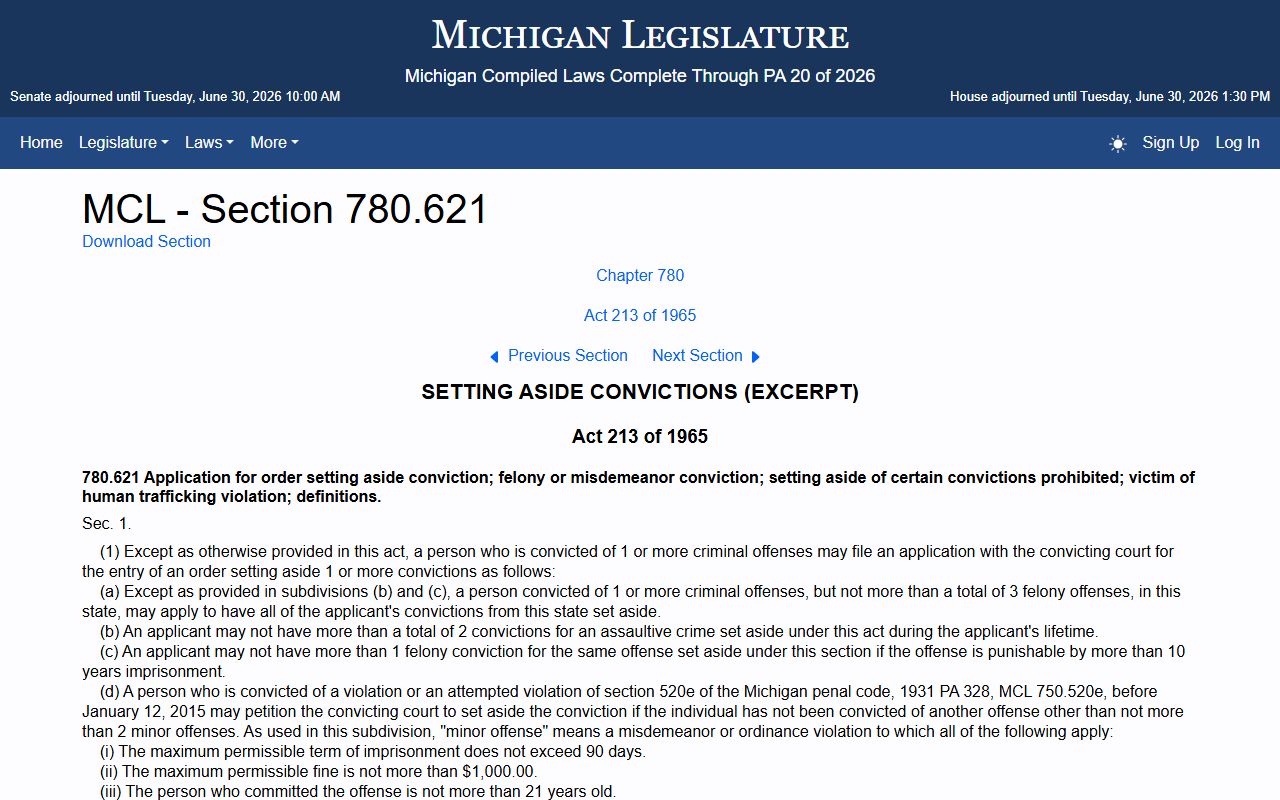
That statute is the reason a charge you find today may be gone tomorrow once a set-aside is granted. It shifts the record out of ordinary public view and controls how the charge is handled going forward.
Restricted and Set-Aside Charge Records in Kalkaska County
Not every charge record is open to the public. Juvenile charges, sealed matters, dismissed counts that get withheld, adoption files, and mental health proceedings are the main categories that sit outside the ordinary public record. Juvenile delinquency and adoption run through the family division, and mental health matters run through the probate division, where access is limited by law. Ongoing investigations can also keep certain details out of public view until the case is filed.
Set-aside is the other major limit. Michigan's Clean Slate reforms let many eligible convictions clear, either by petition or automatically. Timing is central to eligibility, and the waiting period statute spells out how long an applicant must wait before a record qualifies. The set-aside waiting-period statute defines those windows.
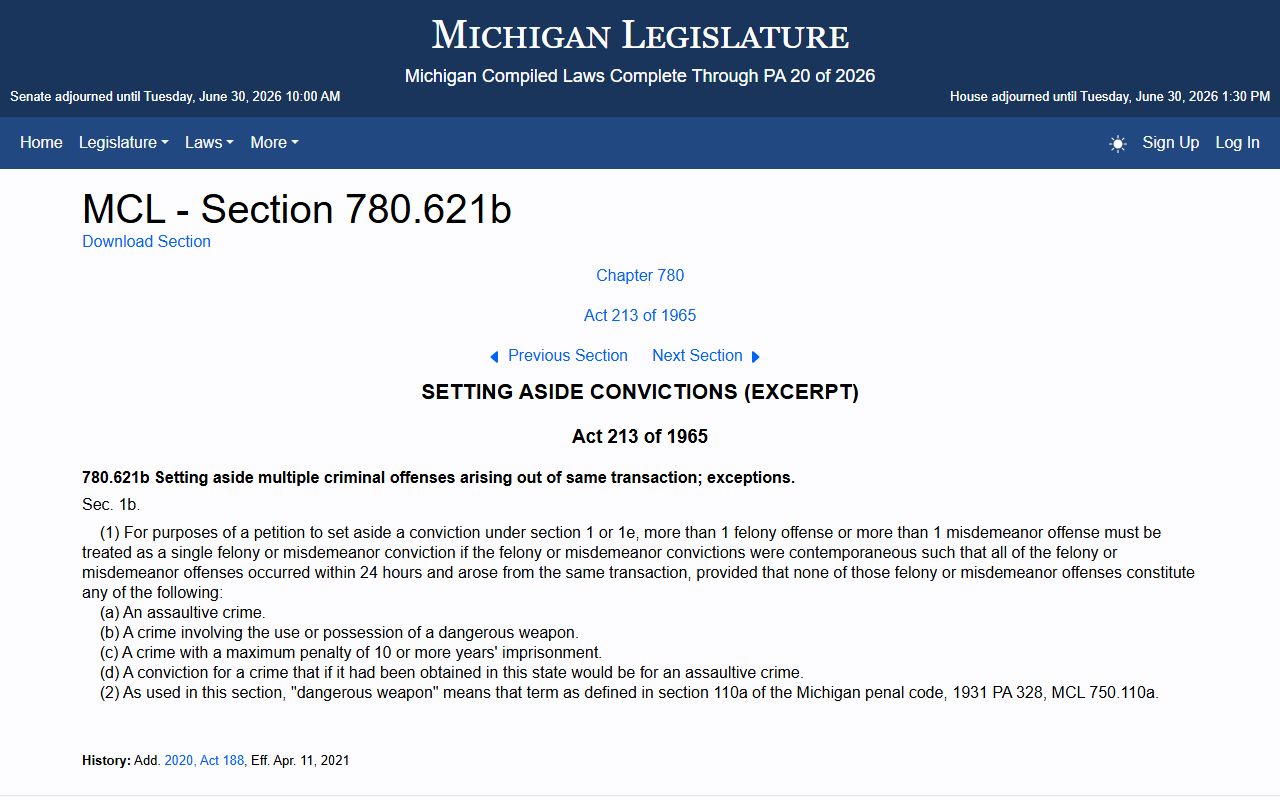
Waiting periods explain why a recent charge cannot be cleared right away, even when the charge type is eligible. Not every conviction can be set aside, though. Some offenses are excluded outright, and certain records carry their own confidentiality rules. The set-aside exclusions statute lists the offenses that do not qualify.
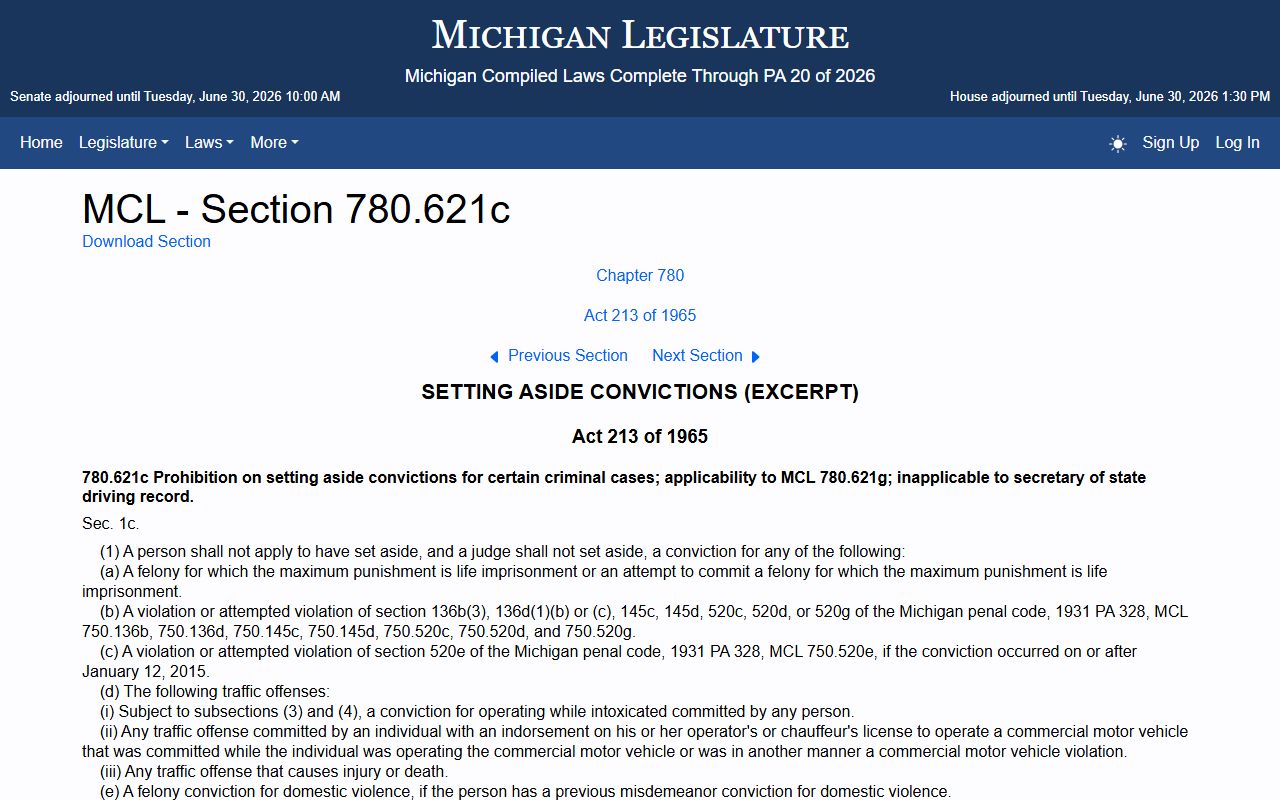
Those exclusions matter because they mark the charges that stay on the record no matter how much time passes. Kalkaska County does not publish its own expungement page, so the process routes through the state. The Attorney General expungement assistance resources and the Clean Slate automatic-expungement page walk through eligibility, the petition path, and the automatic clearing timeline.
Background Check Considerations
Charge records feed into background checks, but not every lookup is a legal background check. A casual name search on the district portal is fine for personal use. A screening for a job, an apartment, or credit falls under federal rules and must run through a compliant provider. That difference protects the person being screened and keeps the user on the right side of the law.
Important: This site is not a consumer reporting agency under the Fair Credit Reporting Act, and its data may not be used for employment, tenant, credit, or insurance screening.