
How to Search Kalkaska County Court Records
The main public case tool for the county is the 87-B District Court case and payment search. It is name driven and free to use, and it lets a person look up a case, then click the case number to view detail or make a payment. The system is a convenience tool, not the full official file. Two rules matter before you trust a result. Tickets received in the last five days may not be in the system yet, and if a bond was posted, that amount should be subtracted before you pay.
The county exposes its live case tool on the 87-B District Court case and payment page, and the search screen is simple to run.
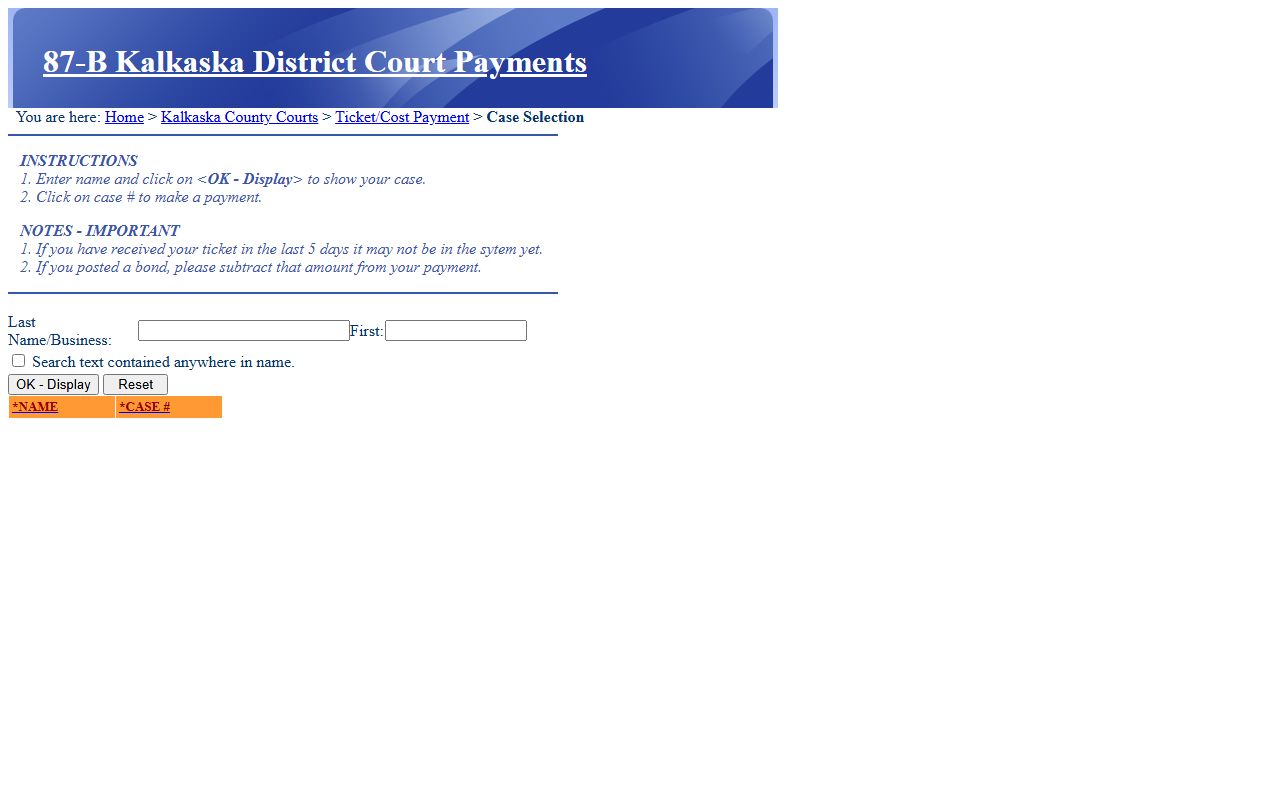
The same screen runs a surname search and links each case number to its payment and detail view. Start with a last name, add a first name to narrow the list, and check the broad-match box when the exact spelling is unclear.
- Open the county courts page or go straight to the 87-B district case and payment portal.
- Type a last name or business name in the search box.
- Add a first name, or check the broad-match option if you are unsure of the name.
- Click OK - Display to run the search and read the name and case number list.
- Click a case number to open the balance, charge, and payment detail.
- Remember the five-day lag on new tickets, and subtract any bond already posted before paying.
The portal search fields are short, which keeps the lookup fast:
| Field | Type | Required | Notes |
|---|---|---|---|
| Last Name / Business | text | Yes for a useful search | Search by surname or business name. |
| First | text | No | Narrows the result by first name. |
| Search text anywhere in name | checkbox | No | Broadens the match to any name text. |
| OK - Display | button | Yes | Runs the search. |
| Reset | button | No | Clears the form. |
Statewide coverage runs through the MiCOURT case-search portal maintained by the Michigan courts.
That system reaches trial courts that publish to the state index, so it is a useful cross-check when the county portal comes up short. For older or non-digital files, the county clerk remains the office that holds the record, and a public-records request is the fallback when nothing shows online.
Types of Court Records Available in Kalkaska County
The county record landscape is easiest to read by division. Each division keeps its own case class, and one matter can touch more than one office. A divorce with minor children, for example, opens a circuit case and also pulls in Friend of the Court for support and parenting time.
The county's own Michigan courts page posts the courthouse address, hours, and the case-search notice.
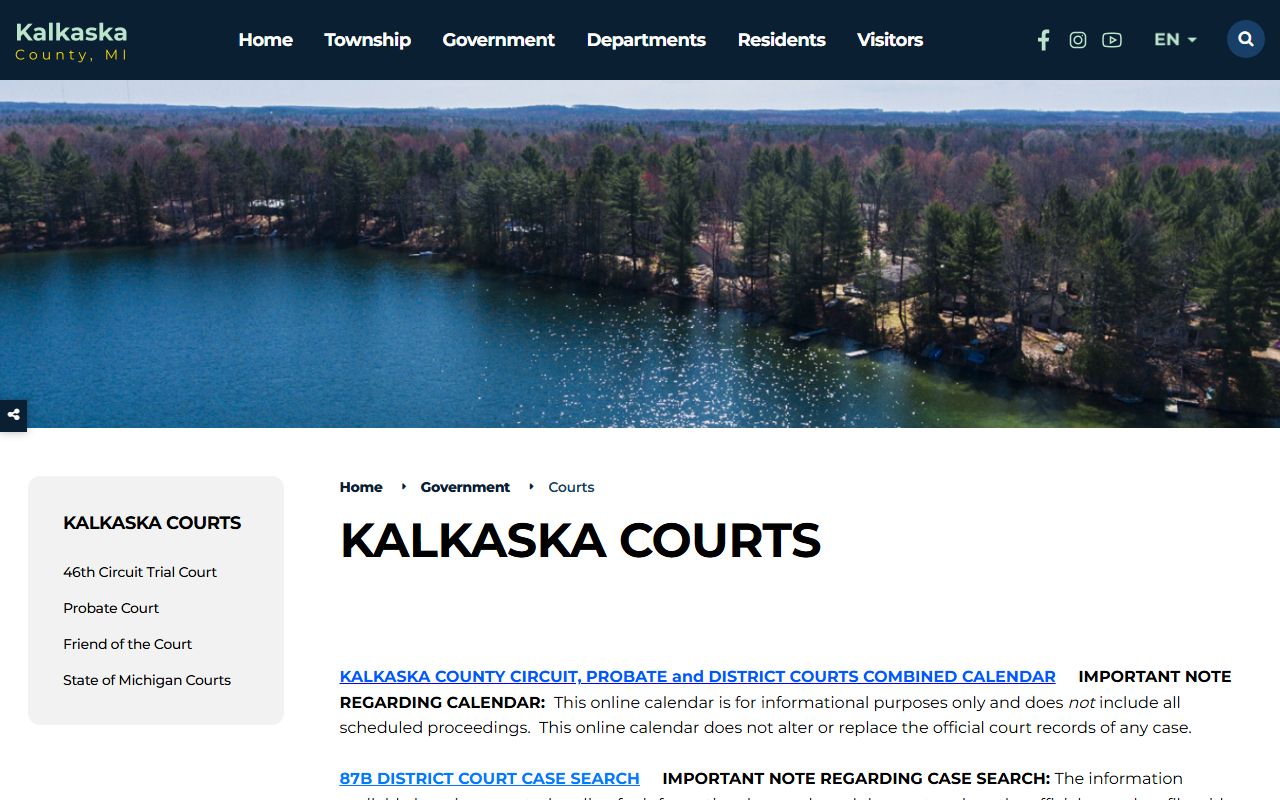
It also carries the ADA accommodation note and the combined-calendar link for hearing dates. The record types that flow through the courthouse break down like this:
- Criminal records - misdemeanors in the district division, and felonies that start in district and move to circuit after bindover.
- Civil records - money claims, judgments, and small claims, split by dollar amount between district and circuit.
- Family and divorce records - divorce, custody, paternity, juvenile, and adoption cases in the family division.
- Probate records - estates, wills, trusts, guardianships, and conservatorships handled by the probate division.
- Traffic records - civil infractions, misdemeanor tickets, and parking matters heard in the district division.
Juvenile files sit apart from the rest. Delinquency and child-protection matters are limited-access records, so they are not open the way an ordinary civil docket is.
Inside the Kalkaska County Court System
Michigan uses circuit courts, district courts, and probate courts as its trial-court base. In Kalkaska County those functions are unified on one campus. The 46th Circuit, the 87-B District Court, the Probate Court, and the Family Division all sit at the same North Birch Street address, and the county clerk serves as clerk for the circuit court. The 46th Circuit Court hears felony trials, larger civil cases, and divorce, while the district division handles misdemeanors, civil infractions, small claims, and the early stages of felonies.
The 46th Circuit Court Kalkaska landing page gathers the local divisions in one place.
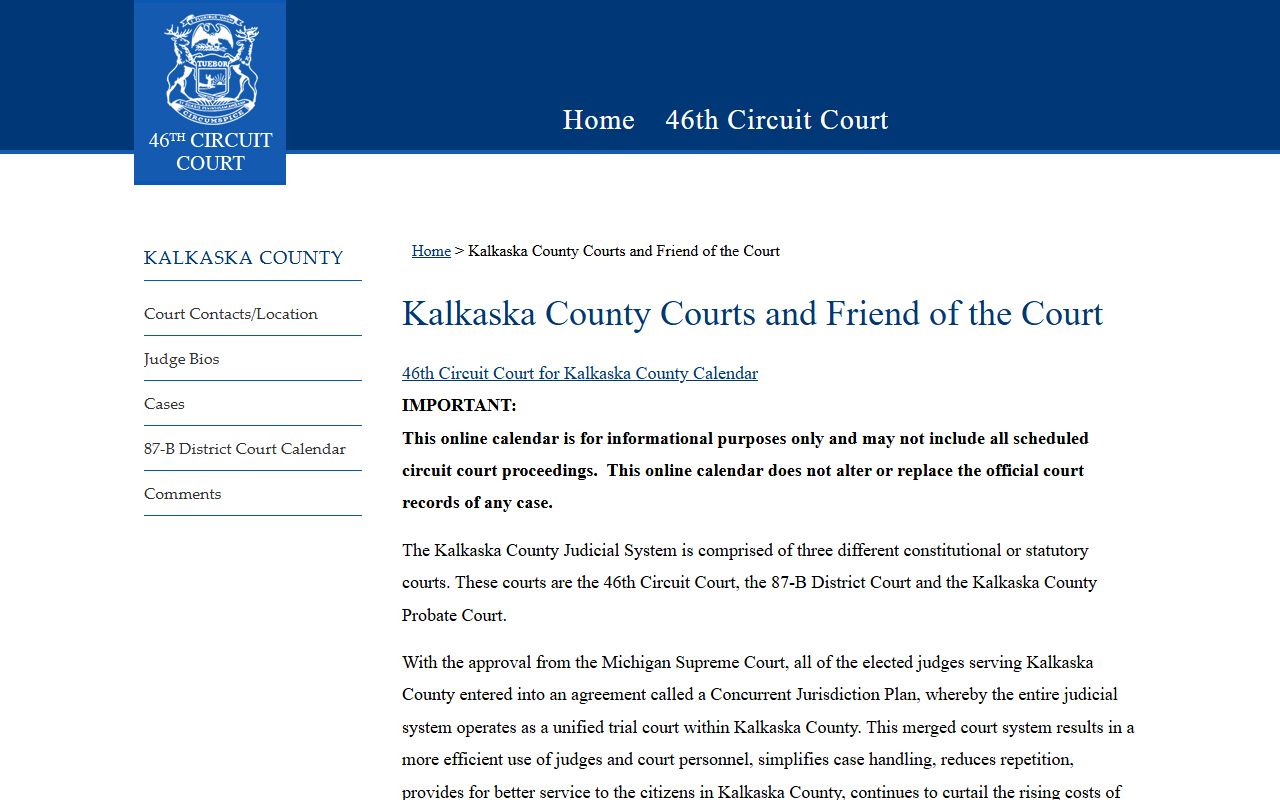
It confirms that circuit, district, and probate work all sit under the same unified trial-court roof. Appeals do not stay local. A case that leaves the trial level moves up the state ladder.
Case flow: District Division › 46th Circuit Court › Michigan Court of Appeals › Michigan Supreme Court
The bench is small and the roles overlap. Judge and division names appear on the court contacts and location page.
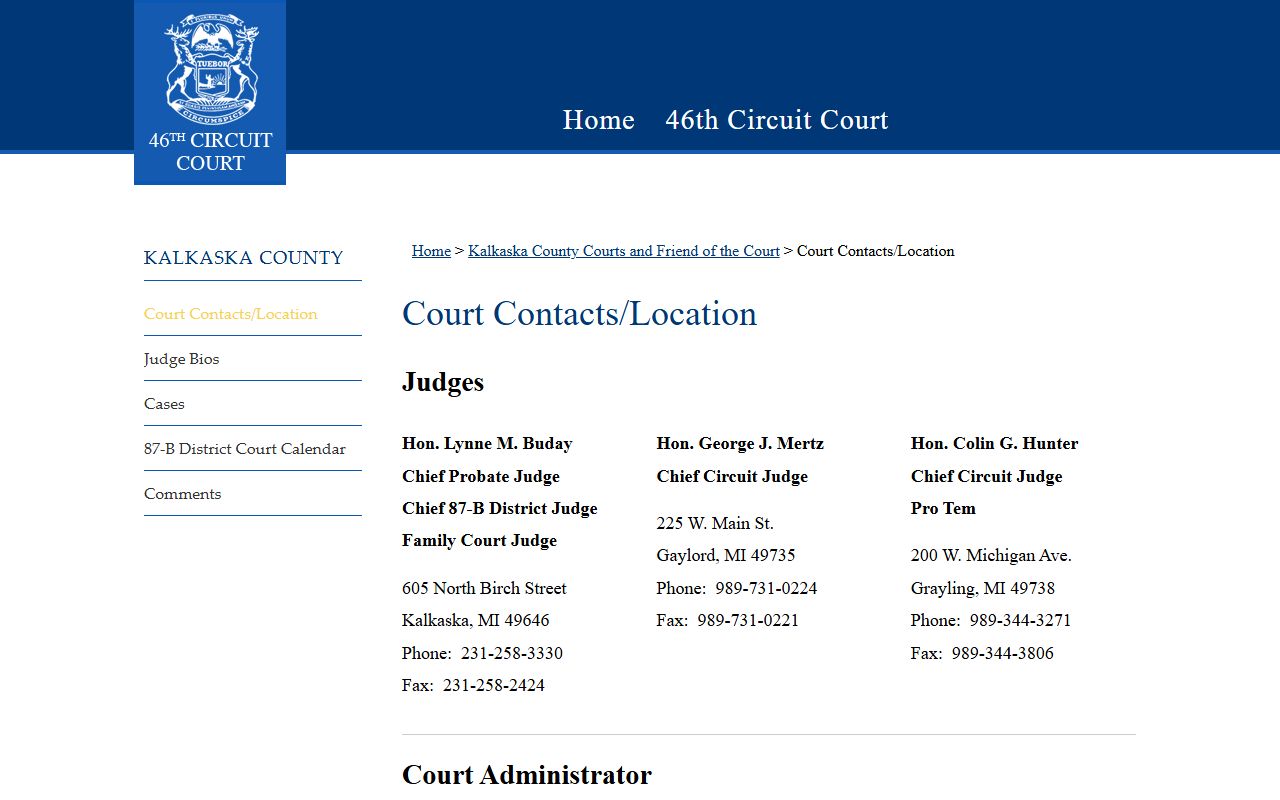
Each division keeps its own line, which matters when a court-records question belongs to probate rather than the district desk. Hon. Janet M. Allen serves as 46th Circuit Court chief judge, Hon. Lynne M. Buday is chief probate and district judge, and Hon. George J. Mertz is a circuit judge.
Kalkaska County Court Types Compared
Because the divisions share a building, it is easy to mix them up. The line between them is really about case type and dollar value. A quick side-by-side helps a searcher decide which desk to call before making the trip downtown.
| Court | Handles | Common Records |
|---|---|---|
| 46th Circuit Court | Felony trials, civil over $25,000, divorce, family-law appeals | Judgments, verdicts, divorce decrees, circuit orders |
| 87-B District Court | Misdemeanors, civil infractions, small claims, civil under $25,000, early felony stages | Citations, arraignments, pleas, dispositions, payment records |
| Probate Court | Estates, wills, trusts, guardianships, conservatorships, mental-health matters | Inventories, accounts, letters of authority, guardianship orders |
The routing page for the courthouse spells out the split further. General civil under $25,000 stays in district, larger civil goes to circuit, name changes go to family, and guardianships go to probate. Personal protection orders are filed with the county clerk, which is one more reason the clerk sits at the center of the county record system.
What Kalkaska County Court Records Show
A public case record shows more than a name and a charge. The sample district case detail on the county portal displays a case number, the party name, the money assessed and paid, the balance due, and a charge table. It also lists jail and probation terms and a comment field. One county record, for example, showed a domestic-violence count with a 2023 adjudication date and a dismissed judgment. The fields a reader actually sees line up like this:
- Case number - the court identifier, such as 2326772SM2 on a district file.
- Party name - the person or business tied to the case.
- Amount assessed, paid, and balance due - the running money owed on the case.
- Jail and probation terms - years, months, and days ordered, when they apply.
- Charge table - count, charge, adjudication date, and judgment for each count.
- Comment - notes such as a reminder that the assessed amount does not include restitution.
Case-number patterns are not uniform across systems. A district file may read 2326772SM2, while a felony record in a state database may read 2002-2197-FH. That difference is normal, and it means a searcher should not expect one format to fit every court.
Public Access Laws for Kalkaska County Court Records
Michigan court records are presumed public, but the file you want may sit behind one of three gates: the online portal, the clerk's counter, or a public-records request. State law sets the frame for what stays open, what can be charged, and what can be withheld. The county's own court page repeats the point, warning that its case search and calendar are informational only and do not replace the official record.
Key statutes and court rules:
MCL 15.231 - the Michigan Freedom of Information Act, which gives the public a right to records held by public bodies.
MCL 15.233 - sets the response rules; a public body must answer a request within the legal timeline and may grant, deny, or partly disclose.
MCL 15.234 - the fee section, which limits the search, labor, and copy costs a public body can charge.
MCL 15.243 - lists the exemptions, the categories of records that can be withheld or redacted.
MCR 8.119 - the court-records rule; court files are presumptively public, subject to sealing, confidentiality, and access limits.
The clerk is the office that holds official and historic files, and its records reach back to 1871. When a record is not posted online, a written request through the county FOIA page is the standard fallback.
Records That Are Restricted or Confidential
Some files are closed or open only in part. In Michigan the main restricted classes are juvenile delinquency and child-protection files, adoption records, mental-health commitment matters, sealed records, and set-aside criminal records. Even an open file can carry redactions that hide a minor's name, a Social Security number, or an account number. The county routes these matters to specific desks: juvenile and adoption cases to the family division, and guardianship, conservatorship, and mental-health matters to probate.
Setting a conviction aside removes its public visibility. The process is statutory, and the county does not run a local expungement page, so the real work happens under state law and through the state attorney general. A person seeking a set-aside generally moves through these steps:
- Confirm the conviction is eligible under Michigan's set-aside statute.
- Check the waiting period and whether the case falls under automatic expungement or an exclusion.
- Gather the old case number and the conviction details.
- File the petition in the court that handled the case.
- Pay the filing fee unless it is waived, and attend a hearing if one is set.
The state expungement-assistance program is the best starting point for eligibility questions and forms.
Note: Confirm any sealed or set-aside status with the court before relying on an online result, because a public portal may not reflect a recent order.
Kalkaska County Sheriff and Jail
Sheriff Pat Whiteford leads the county office, with Undersheriff David Wagner. The jail is an adult facility with a capacity of 62, and its staff book arrests, take fingerprints and photos, handle bonds, and move people to and from court. There is one important local wrinkle. Because the sheriff's facility runs as a lock-down site, county inmates are currently housed in Wexford County, which changes where the live custody rules come from.
The Kalkaska County Sheriff homepage outlines the office and its staffing.
The sheriff books arrests, but the site does not run a public roster grid. Direct phone lines, fax, and email sit on the sheriff contact page.
Those numbers are the practical route for jail and custody questions because inmates are housed in Wexford County. For the full custody picture, the county inmate records page walks through the sheriff contact, the Wexford housing path, and the state OTIS system for people under prison or parole supervision. Because there is no public active-warrant list here, the warrant records page covers the phone, court, and records-request routes for checking a bench warrant.
Marriage, Divorce, and Probate Records
Vital records and probate files follow their own paths. A marriage license comes from the county clerk, and the license fee is $20 under MCL 551.103. A license expires if the marriage is not performed within 33 days. Certified copies of marriage and divorce records are ordered through the state vital-records office rather than the clerk, and those records reach far back, to 1867 for marriage and 1897 for divorce. The county's marriage and divorce records page covers the license steps, the copy fees, and the state order forms in full.
Probate is a distinct record class. It covers estates, wills, trusts, guardianships, conservatorships, and some mental-health matters, and the county probate records page lays out the filing fees and forms. A few terms come up again and again in these files:
- Testator
- A person who makes a will.
- Executor
- The person named to carry out the terms of a will.
- Intestate
- Dying without a valid will, which sends the estate to state default rules.
- Conservator
- Someone a court appoints to manage another adult's finances.
- Disposition
- The final outcome recorded on a case, such as dismissed, guilty, or granted.
- Bench warrant
- A court order to arrest a person and bring them before the issuing court.
Kalkaska County Court Records Fees
Fees vary by the office and the record. The county clerk sets the marriage-license charge, the courts set filing fees, the state vital-records office sets certified-copy charges, and the Secretary of State sets driving-record prices. The most common charges tied to court and vital records look like this:
| Item | Amount |
|---|---|
| Marriage license (county clerk) | $20.00 |
| Certified marriage record copy (state, one-year search) | $34.00 |
| Each additional certified copy | $16.00 |
| Circuit court civil filing | $150.00 |
| Electronic filing system fee (civil) | $25.00 |
| Will filed for safekeeping (probate) | $25.00 |
| Probate motion or objection | $20.00 |
| Certified Michigan driving record (Secretary of State) | $16.00 |
A fee waiver may apply for people who cannot pay, and the probate inventory fee is figured separately through the state inventory calculator. Always confirm the current charge with the office that holds the record, since fee tables update over time.
Kalkaska County Clerk and Records Access
Deborah Hill is the Kalkaska County Clerk, and the office is the practical hub for county records. The clerk serves as clerk of the 46th Circuit Court and also handles elections, the jury board, and several county boards. Its files begin with the year 1871, which makes the office the deepest paper trail in the county. Genealogy research is allowed by mail or in person, so the counter is a research repository, not just a filing desk.
The county clerk page lists the office address, hours, and the clerk's court role.
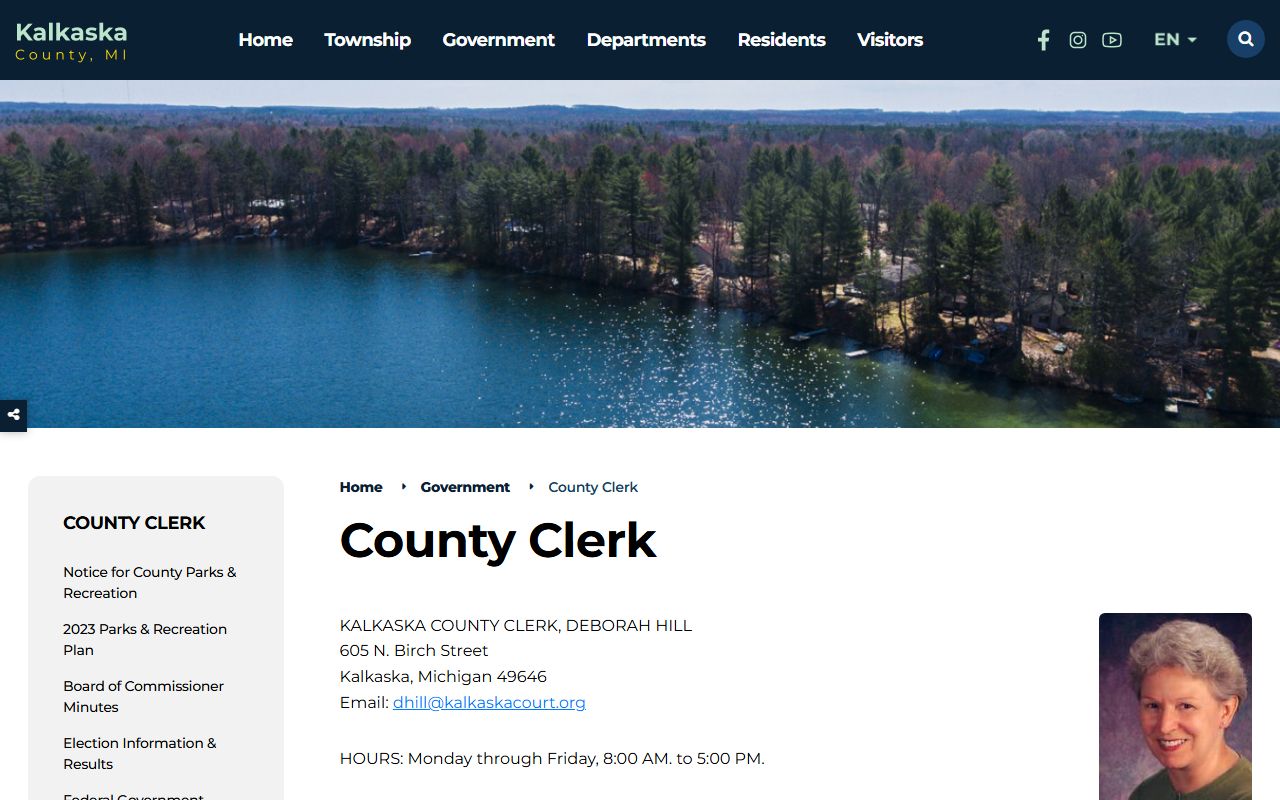
It notes that clerk records reach back to 1871, which anchors the county's oldest public files. The broader Kalkaska County homepage links every office on the campus.
From there a resident can reach the clerk, courts, sheriff, and register of deeds without hunting across sites. The county clerk of court page details request methods, forms, and hours for certified copies and older files.
Federal Court Coverage for Kalkaska County
Not every case in the county is a state case. Kalkaska County sits in the Western District of Michigan for federal matters, and the district lists the county among the areas it serves. Its courthouses sit in Grand Rapids, Lansing, Kalamazoo, and Marquette, none of them in Kalkaska. Federal criminal, civil, and bankruptcy files are searched through PACER and the district's CM/ECF system, not the county portal.
Federal matters route to the United States District Court for the Western District of Michigan.
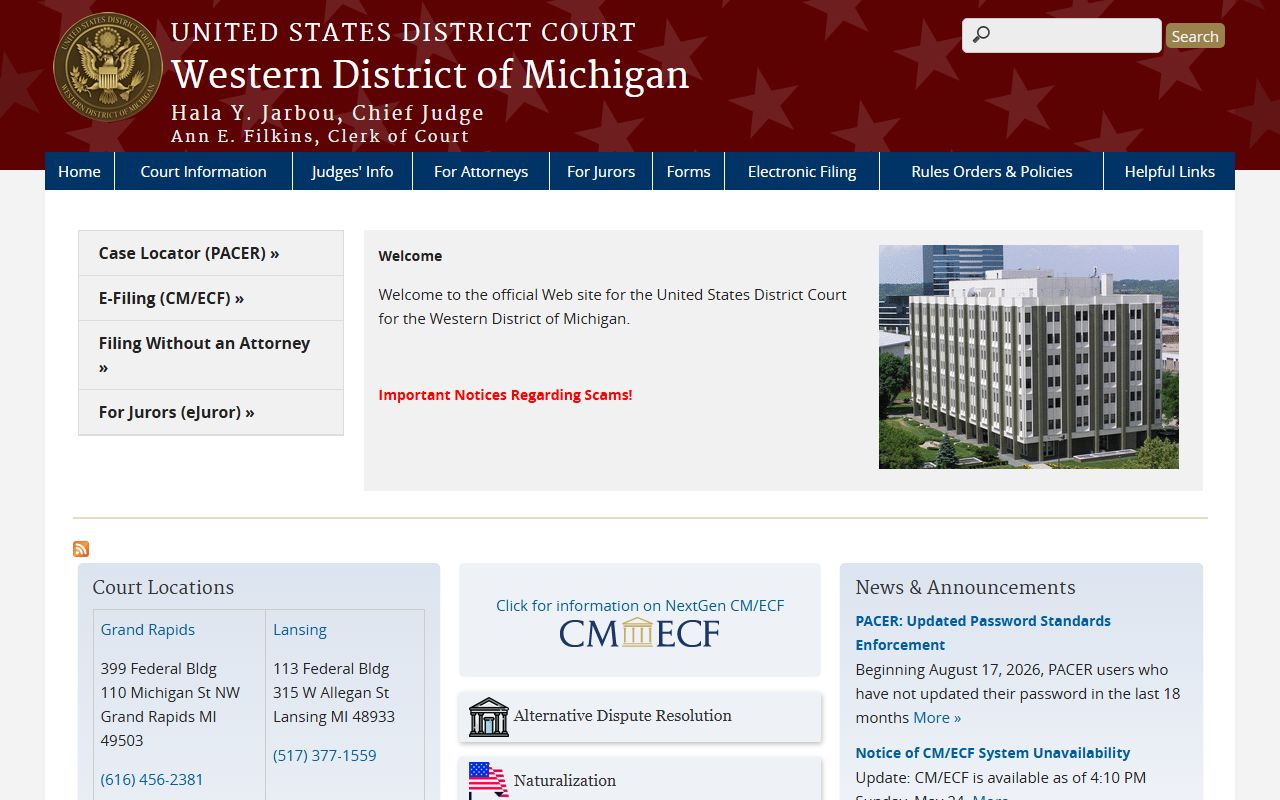
That court, not the county courthouse, holds federal criminal, civil, and bankruptcy records for the area. Appeals from the Western District move to the Sixth Circuit, and the district's home page links its locations, filing tools, and public-access rules.
Kalkaska County Courthouse Location and Contact
Everything centers on one address. The courthouse, the clerk, the register of deeds, and the prosecutor all cluster on the same downtown block at the county seat, so a visitor can often handle court, clerk, and records business without leaving the campus. Court offices are open weekdays until 4:30 p.m., and an outdoor dropbox takes certain filings after hours. A document dropped after 4:00 p.m., or on a day the court is closed, is treated as received the next business day.
Kalkaska County Courthouse
605 North Birch Street
Kalkaska, MI 49646
(231) 258-3330
Hours: Monday to Friday, 8:00 a.m. to 4:30 p.m.
Division lines split by topic. The probate and court administrator desk answers at (231) 258-3330, the district division at (231) 258-9031, the family division at (231) 258-3314, and the circuit court clerk at (231) 258-3349. The court also posts an ADA accommodation process, with a coordinator reachable at (231) 258-3330 ext. 4.
History of Kalkaska County Courts
The county's public record runs deep. Clerk records begin in 1871, and the register of deeds has kept grantor and grantee books since January 27 of that same year. The county's genealogical society formed in 1989 to gather and preserve local history, and both the clerk and the register of deeds point researchers toward those history resources.
The current bench reflects a small, tight legal community. Judge Allen joined the circuit court in 2005 and became chief judge in 2008. Judge Buday took the probate bench in 1998, and Judge Mertz joined the circuit court in 2013. The court also sends a biweekly newsletter to help the public understand the Michigan judicial system, a sign the courthouse leans toward plain-language public information.
Frequently Asked Questions
Where do I search Kalkaska County Court cases online?
Start with the 87-B District Court case and payment portal, which is name driven and free. Enter a last name, add a first name to narrow the list, then click a case number for the balance and charge detail. For a broader net, the state MiCOURT portal reaches trial courts that publish to the state index. Neither tool is the full official record, so the clerk remains the office for older or missing files.
Why do new tickets not appear right away?
The district portal notes a lag. Tickets received in the last five days may not be in the system yet. If you do not see a recent citation, wait a few days and search again, or call the court. If you already posted a bond, subtract that amount before you pay, since the portal balance may not reflect it.
Does Kalkaska County post a jail roster or warrant list online?
No. The sheriff's site does not run a public roster grid, and there is no active-warrant portal. County inmates are housed in Wexford County, so custody questions go to the sheriff's phone lines. To check a warrant, call the sheriff, contact the issuing court, or file a public-records request. The inmate and warrant pages on this site map out each route.
How do I get a certified marriage or divorce copy?
Certified copies come from the state vital-records office, not the county clerk. The base marriage-copy fee is $34 and includes a one-year search, with extra certified copies at $16 each. Marriage records reach back to 1867 and divorce records to 1897. The county clerk still issues the marriage license itself, which costs $20 and expires after 33 days.
What records are not open to the public?
Juvenile delinquency and child-protection files, adoption records, mental-health commitments, sealed files, and set-aside convictions are restricted or closed. Even open files can carry redactions that hide minors, Social Security numbers, and account numbers. A set-aside removes a conviction's public visibility, and that process runs under state law rather than a local county program.
Which court handles my type of case?
It depends on the matter. Misdemeanors, small claims, and traffic go to the district division, while felonies and larger civil cases and divorce go to circuit. Estates, guardianships, and conservatorships go to probate, and name changes and juvenile cases go to family. Personal protection orders are filed with the county clerk.
What if the record I need is not online?
Go to the clerk. The county clerk holds official and historic files back to 1871, and staff allow research by mail or in person. When a record is not posted, a written FOIA request through the county is the standard fallback. Certified copies and older paper files are handled at the counter rather than through the case portal.