
Criminal Court Records in Kalkaska County
A Kalkaska County criminal court record is the official case file that opens once a prosecutor charges someone with a crime. The clerk builds it and keeps it. Inside sit the charging papers, the docket of every hearing, the judge's orders, the plea or verdict, and the sentence. It is far more than a booking sheet. It is the running story of one case as it moves through the court, and it stays a public record long after the case closes. For the charges themselves, viewed on their own, see the county arrest records and court charges page.
Two courts handle criminal matters here, and both share the courthouse on North Birch Street. The 87-B District Court hears misdemeanors, the lower-level crimes that carry up to a year in jail. It also handles the early stages of every felony. The 46th Circuit Court hears felony trials, the serious crimes that can bring a prison term. A felony starts in district court, clears a preliminary exam, then binds over to circuit court for trial and sentencing. Each move leaves an entry in the file. This is only one slice of the county's records; the broader court records system also holds civil, family, and probate cases.
How Criminal Cases Move in Kalkaska County
A criminal case follows a set path, and each step adds a layer to the file. Reading a record is easier once you know the order. The case opens with a charge and ends with a sentence or a dismissal. Felonies pass through more steps than misdemeanors because of the preliminary exam and the bindover to circuit court.
Case flow: Charges Filed › Arraignment › Preliminary Exam / Pretrial › Plea or Trial › Disposition › Sentencing
The county's own criminal-matters page walks through these stages and warns that a missed hearing can trigger a warrant. That page is worth a look before you read a live file, and it can be found on the Kalkaska criminal matters guide.
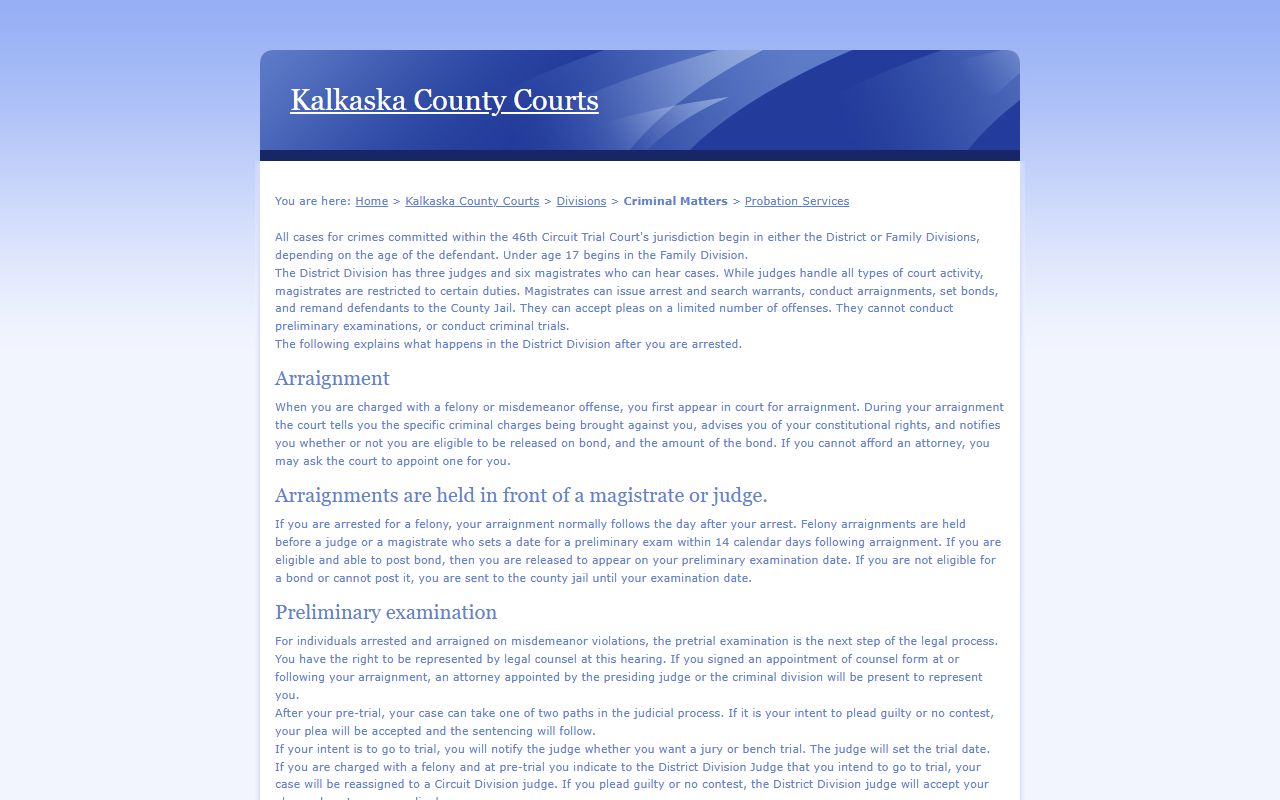
The page lays out arraignment, bond, and the felony bindover in plain terms, which mirrors the entries you will later see on the docket. The table below sums up what happens at the main stages.
| Stage | What Happens |
|---|---|
| Arraignment | The defendant hears the charges, enters a first plea, and the judge or magistrate sets bond and conditions of release. |
| Preliminary Exam / Pretrial | In felony cases the district court decides if there is enough proof to bind the case over to circuit court. Both sides trade motions and discovery. |
| Plea or Trial | The defendant pleads guilty or no contest, or the case goes to a jury or bench trial for a verdict. |
| Sentencing | The judge imposes the penalty: jail or prison time, probation, fines, costs, and any restitution owed to a victim. |
How to Search Kalkaska County Criminal Court Records
The main public tool is the 87-B District Court case search and payment portal. It is name-driven and free to use. It shows district cases, which cover misdemeanors and the early felony stages, and it lets you click a case number to view detail or pay a balance. Newly filed tickets can lag by up to five days, so a fresh case may not show at once.
- Open the 87-B District Court case search portal.
- Type the defendant's last name or business name, and add a first name to narrow the list.
- Check the broad-match box if you are unsure of the exact spelling of the name.
- Click OK - Display, then click a case number to open the docket, charges, and disposition.
- Ask the Kalkaska County Clerk for a certified copy when you need an official file for court or legal use.
The portal is a convenience tool, not the whole universe of county cases. Circuit court felony files, older records, and any nonpublic matter may not appear online. For those, the county clerk holds the official file, and a FOIA request is the fallback when a record is not posted. A statewide option also exists: the Michigan courts run the MiCOURT case search, which reaches many trial courts across the state.
What a Kalkaska County Criminal Court Record Shows
Open a district case detail page and you see a clear set of fields. The sample record reviewed on the county system showed a case number, the party name, the amount assessed, the amount paid, the balance due, the last payment, a comment line, a jail term in years, months, and days, a probation term in the same form, and a charge table listing each count, the charge, the adjudication date, and the judgment. The fields below are the ones a reader relies on most.
| Field | What It Shows |
|---|---|
| Case Number | The court's unique file ID, such as 2326772SM2. Formats differ by court and case type, so patterns are not uniform across systems. |
| Defendant | The named party the case is filed against, shown as last name first, for example BENOIT JR, MAURICE. |
| Charge and Count | Each count listed on its own row with the charge name, so a file can carry several charges at once. |
| Adjudication Date | The date the court resolved that count, tied to the judgment entry. |
| Judgment | The outcome for the count, such as dismissed, guilty, or another disposition. |
| Jail and Probation Term | Any custody time and probation length, each broken into years, months, and days. |
| Financial Fields | Amount assessed, amount paid, balance due, and last payment. A note may add that the assessed amount does not include restitution ordered. |
One caution on the money side. If a bond was posted, it should be subtracted from the amount owed before any payment. The record's comment line often carries these details, and the clerk can confirm a balance if the figures look off.
Charges vs. Convictions in the Record
A charge is not a conviction, and a criminal court record can show both. Being charged only means a prosecutor believes there is probable cause to accuse someone. A conviction means the case ended in a guilty plea or a guilty verdict. The sample file makes the gap plain: it listed a Domestic Violence charge with an adjudication date of 2023-06-07 and a judgment of Dismissed. The charge is real and public, yet no conviction followed.
| Charge | Conviction | |
|---|---|---|
| Stage | Accusation by the prosecutor | Verdict or plea that ends the case |
| Burden of Proof | Probable cause | Beyond a reasonable doubt |
| Possible Outcomes | Dropped, dismissed, reduced, or acquitted | Guilty finding on the record |
| Public Record | Yes | Yes |
This matters for anyone reading a file. A record with many charges may still hold few convictions, since some counts get dropped or dismissed along the way. Read the judgment column, not just the charge list, before drawing any conclusion about a case.
Reading Dispositions and Sentences
The disposition is the outcome of a charge, and the sentence is the penalty that follows a conviction. Common disposition entries include guilty, not guilty, dismissed, and no contest, sometimes shown as nolo. A deferred outcome can also appear, where the court holds the case open while the defendant meets set terms. The judgment column in the case file carries these results count by count.
Sentences in the record break into parts. A jail or prison term appears in years, months, and days. Probation shows the same way, and misdemeanor probation is a common outcome in district court. Fines, court costs, and restitution to a victim round out the money side. Kalkaska's district probation office ties treatment programs to many of these sentences, including substance abuse assessment, a victim impact panel, domestic abuse intervention, and driver improvement work.
The county's probation-services page explains how these terms and programs work after sentencing, and it can be read on the 87-B District Court probation page.
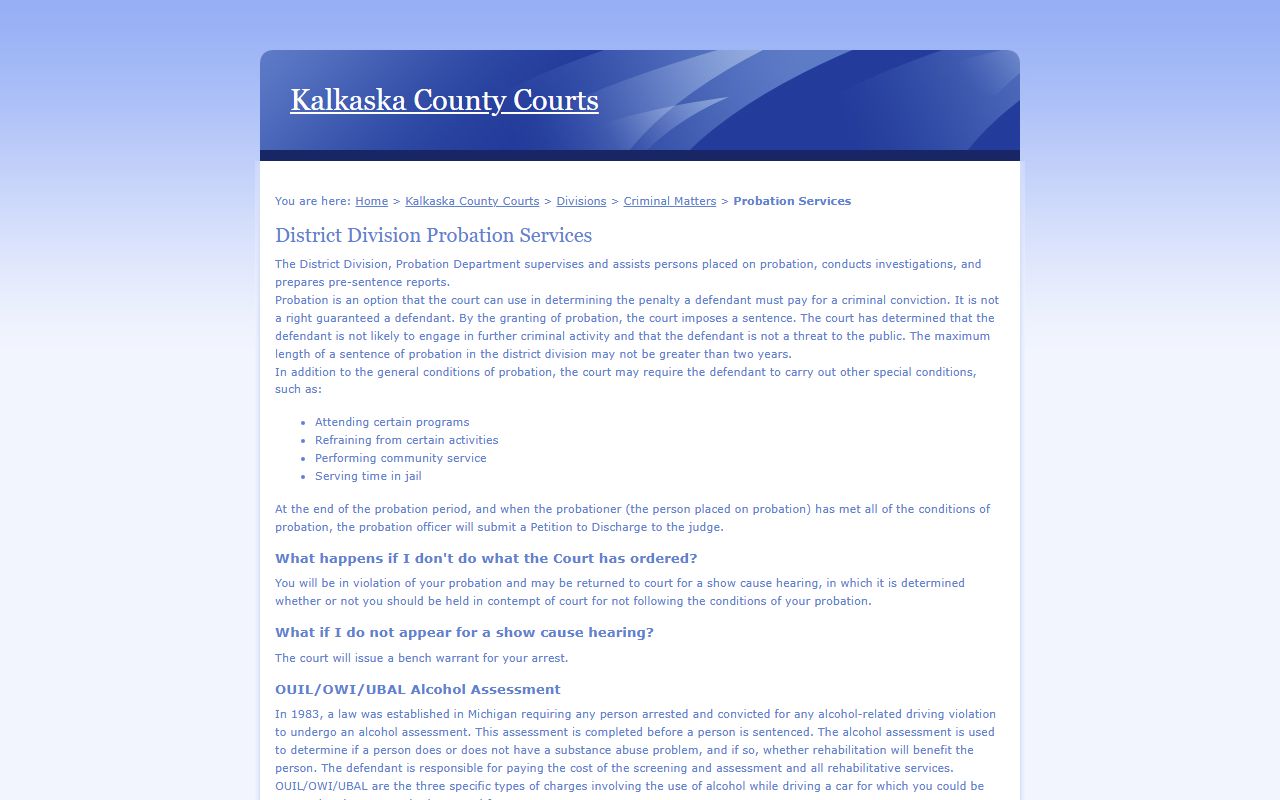
The page shows how OWI and related offenders may face alcohol screening and pay their own rehabilitation costs, which is the kind of detail a sentence entry only hints at. Reading the disposition next to the probation terms gives the fullest picture of what a case actually cost the defendant.
Note: A sentence in the file may still change if probation is violated, which can add a new hearing and, in some cases, jail time.
Warrants and Failure to Appear
A criminal file can also hold a warrant. When a defendant skips a hearing or fails to resolve a matter, the court can issue a bench warrant, an order to arrest the person and bring them before the judge. Failure to appear can also suspend a driver license in traffic-linked cases. These entries sit right in the docket alongside the charges and orders.
Magistrates in the 46th Circuit system do much of the early warrant work. They examine affidavits for search warrants, weigh probable cause, run first-appearance arraignments, and set or deny bail. The probation-officer job description spells out these duties, and it is posted on the county's court staff role page.
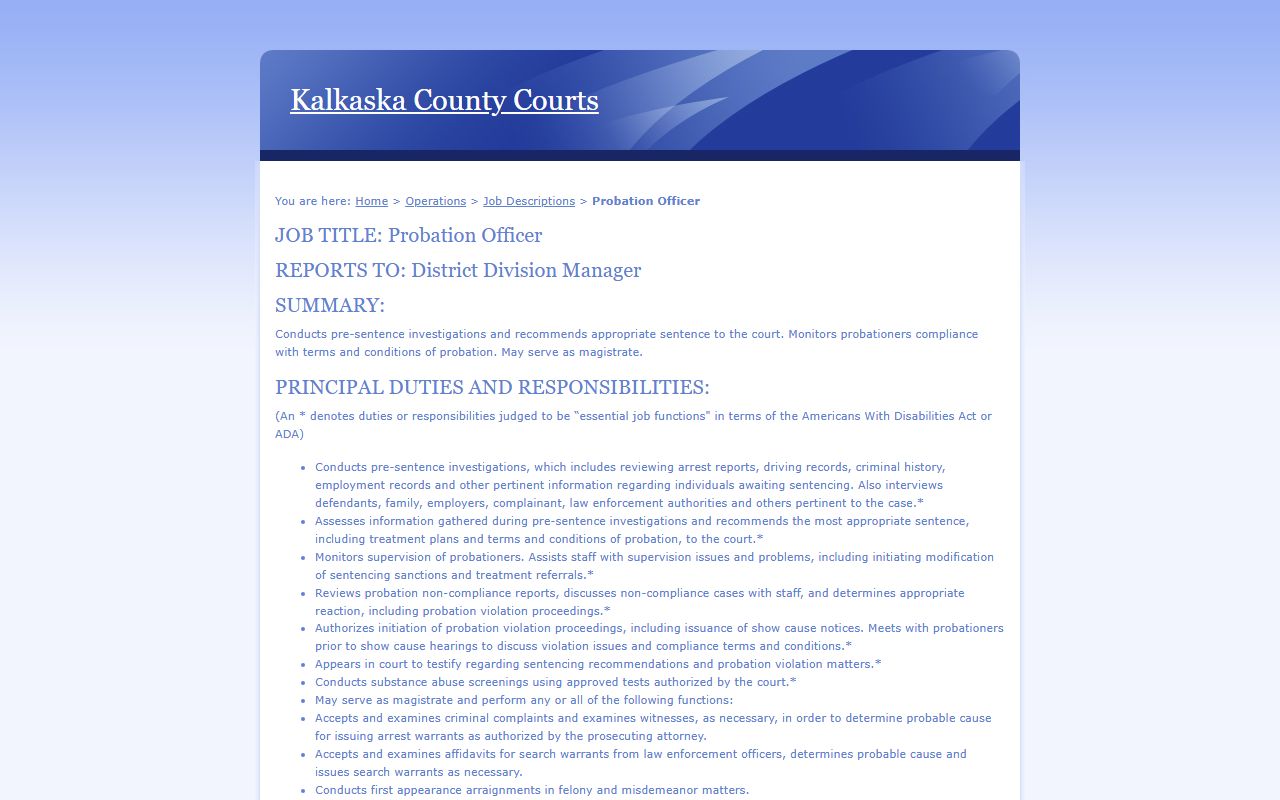
Seeing the magistrate and warrant duties laid out helps explain why arraignment and bond entries appear so early in a file. The county publishes no public active-warrant list, so a call to the sheriff or the issuing court, or a records request, is the way to confirm an open warrant.
Sealed vs. Expunged Records
Not every criminal record stays open forever. Michigan lets people set aside, or expunge, many old convictions, which removes the practical public view of the case. Sealing is different: a sealed file is hidden from the public but not destroyed. Both terms come up when people want an old case off the record, and they work in different ways.
| Sealed | Expunged | |
|---|---|---|
| Visibility | Hidden from public view | Set aside and treated as if it never happened |
| Law Enforcement | Limited access remains | Very limited access remains |
| Michigan Basis | Court sealing under MCR 8.119 and case-specific orders | Set-aside under MCL 780.621 and the Clean Slate law |
| How It Happens | By court order on a filed request | By petition, or automatically for eligible cases |
Michigan's set-aside statutes, the MCL 780.621 series, control who qualifies and how long they must wait. The Clean Slate law added automatic expungement for many eligible convictions, so some records clear without a petition. The county does not run its own expungement office, so the state does the real work here. The Michigan Attorney General runs an expungement assistance page with current guidance.
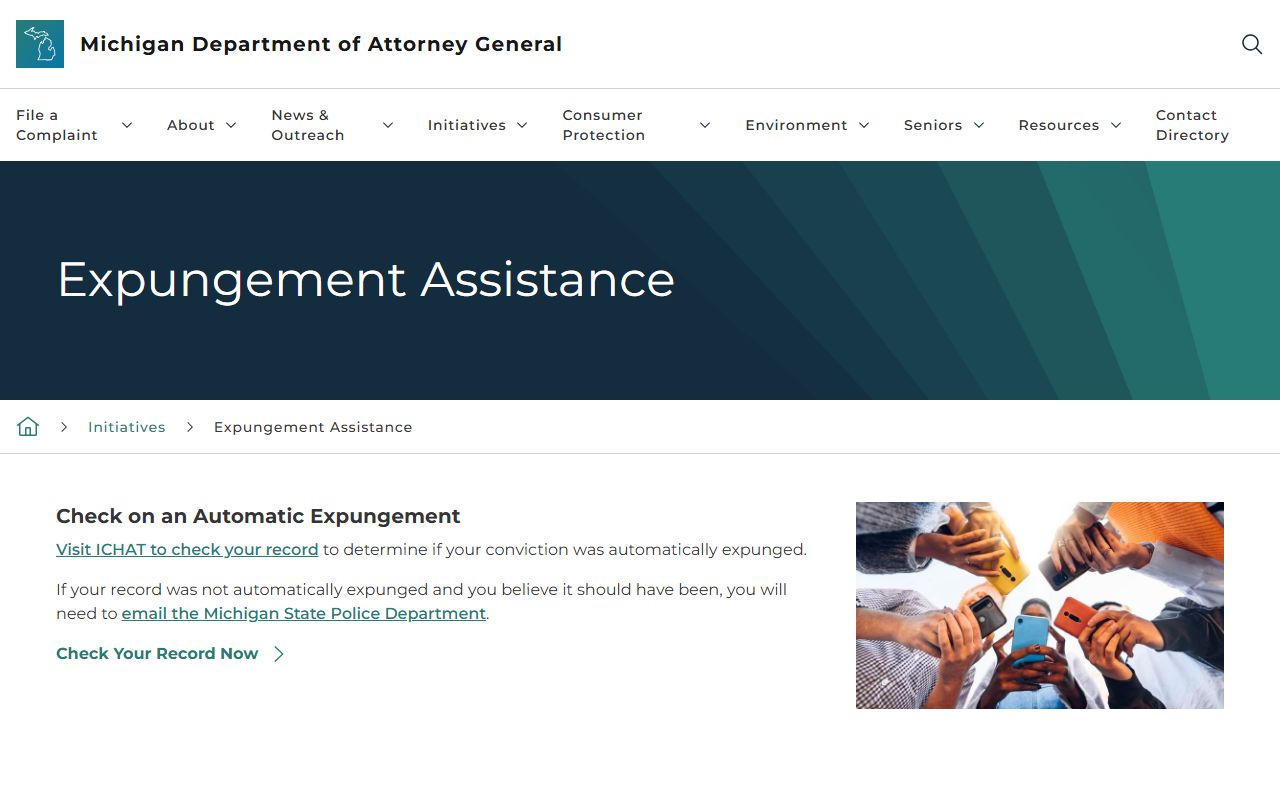
That resource points people to eligibility rules, forms, and clinics, which is the right route when a Kalkaska file needs to be cleared. To confirm whether a case is eligible, check the conviction type against the statute, then file the petition in the court that heard the case.
Public Access to Criminal Court Records
Court records in Michigan are presumed public, but access runs through set gates. The case portal is the convenient front door, the clerk holds the official file and certified copies, and a FOIA request is the fallback for records not posted online. Court rules and open-records law decide what can be withheld, sealed, or redacted. Juvenile, adoption, mental-health, sealed, and expunged files are the main categories kept from open view.
Key Statutes:
Michigan MCL 15.231 - the Freedom of Information Act, which sets the public's right to records held by government bodies.
MCR 8.119 - the court-records rule that makes case files presumptively public, subject to sealing and confidentiality limits.
MCL 780.621 - the set-aside statute that governs when a criminal conviction can be expunged from public view.
Background Check Considerations
Reading a criminal court file for personal knowledge is not the same as running a formal background check. A background check used to decide on a job, a loan, a rental, or insurance falls under the federal Fair Credit Reporting Act, which sets strict rules on accuracy and use. A casual lookup on the county portal carries no such backing and may miss sealed, expunged, or newly filed matters.
Important: This site is not a consumer reporting agency under the FCRA, and its information may not be used to decide on credit, employment, housing, or insurance.
Restricted Criminal Court Records in Kalkaska County
Some criminal matters never reach the public file. Juvenile delinquency cases run through the family division and are not broad public records. Mental-health commitment matters sit in probate and can be access-limited. Adoption files are more confidential than ordinary cases. Sealed and expunged records fall away from public view by court order or statute.
Even open files can carry redactions. Courts routinely mask minors' names, Social Security numbers, and account numbers while leaving the rest of the record public. An active case may also show fewer entries while it is still moving. When a record is missing or partly hidden, the county clerk is the office to ask, and a FOIA request is the path when a file is not posted online. For related lookups on people held before trial, the county tracks custody separately from the case file.