
Is There an Online Warrant List in Kalkaska County?
There is no public active-warrant portal for Kalkaska County. The sheriff and court pages reviewed do not host a searchable warrant grid, a most-wanted list, or a name-driven warrant lookup. Anyone who wants to know whether a warrant is on file has to work through people and offices, not a website. That is the plain truth of warrant access in this county, and it shapes every step below.
The workable path is a short chain of real contacts. The Kalkaska County Sheriff's Office answers warrant questions by phone at (231) 258-8686, with non-emergency dispatch reachable at (231) 258-3350. The trial court that signed the order is the second stop, and the court administrator line is (231) 258-3330. When the information is not posted, a Michigan Freedom of Information Act request under MCL 15.231 is the fallback that pries records loose from a public body. Each channel is covered in the sections that follow.
State systems help only in narrow cases. They cover people under Michigan Department of Corrections supervision, not local bench warrants signed at the Kalkaska courthouse.
How to Check for a Kalkaska County Warrant
Start with the sheriff and the court, in that order. The sheriff's records and corrections staff can confirm whether an active warrant is in hand for arrest, and the court can confirm a bench warrant tied to a case. Have a full legal name and a date of birth ready, because staff use those to separate one person from another. If a warrant traces back to a specific case, the case number speeds every call.
The sheriff's court section is the unit that transports defendants and works directly with warrant paperwork, and its role is described on the sheriff court-section page.
That page shows how tightly warrant work is bound to the jail and the courtroom, which is why a phone call to the sheriff is the practical first move rather than a web search. Two contact points cover most warrant questions in the county.
Kalkaska County Sheriff's Office
Records and Corrections Division
Main: (231) 258-8686
Non-emergency dispatch: (231) 258-3350
Email: Admin@kalso.org
46th Circuit Trial Court
605 North Birch Street
Kalkaska, MI 49646
Court Administrator: (231) 258-3330
Circuit Court Clerk: (231) 258-3349
Hours: Mon to Fri, 8:00 a.m. to 4:30 p.m.
Types of Warrants in Kalkaska County
Not every warrant means the same thing. A judge or magistrate signs each one for a different reason, and the reason controls who holds it and how it clears. The county's own court materials describe arrest, bench, and search warrants, plus the failure-to-appear orders that flow out of unpaid tickets and missed hearings.
- Arrest warrant - a court order allowing police to take a named person into custody, usually based on a sworn complaint and a finding of probable cause.
- Bench warrant - an order the court issues from the bench to arrest a person and bring that person before the issuing court, often after a missed appearance.
- Search warrant - an order a magistrate signs after reviewing an affidavit, authorizing officers to search a place and seize described items.
- Failure-to-appear warrant - a warrant that follows a missed hearing or unpaid civil infraction, and it can travel with a driver-license suspension.
Most people searching here are looking for an arrest or bench warrant. Search warrants are executed by officers and rarely surface as something a private person needs to look up, though they can later appear in the criminal case file.
How Kalkaska County Magistrates Issue Search Warrants
Warrant authority in the county runs through the magistrate. The probation-officer job description for the trial court spells out the duties: a magistrate accepts and examines affidavits for search warrants, determines probable cause, issues search warrants, conducts first-appearance arraignments, and sets or denies bail. That short list explains why so much warrant activity is tied to the courthouse rather than a standalone office.
Bail is decided at that same early stage. When a person is arrested on a warrant and brought in, the magistrate or judge reviews the charge, sets a bond amount or denies release, and schedules the next step. A few terms come up again and again in this process.
- Magistrate
- A judicial officer who reviews affidavits, issues certain warrants, and handles first appearances and bail.
- Probable cause
- The reasonable basis, shown by sworn facts, that a crime occurred or that evidence sits in a specific place.
- Arraignment
- The first court appearance where a defendant hears the charge and a judge or magistrate addresses bond.
- Bail or bond
- Money or conditions set to release a defendant while a case is pending, or denied when the court finds release unsafe.
Note: A magistrate can deny bail outright, so a warrant does not always come with a fixed dollar amount attached.
Bench Warrants in Kalkaska County Support Cases
Family and support cases produce their own bench warrants, and the Friend of the Court is the office behind them. The FOC legal-secretary role covers preparing, issuing, and recalling bench warrants and coordinating that work with sheriff departments. So a parent who misses a support hearing or falls out of compliance can face a bench warrant that the FOC generated, not the criminal division.
The duties tied to that coordination appear on the Friend of the Court legal-secretary page.
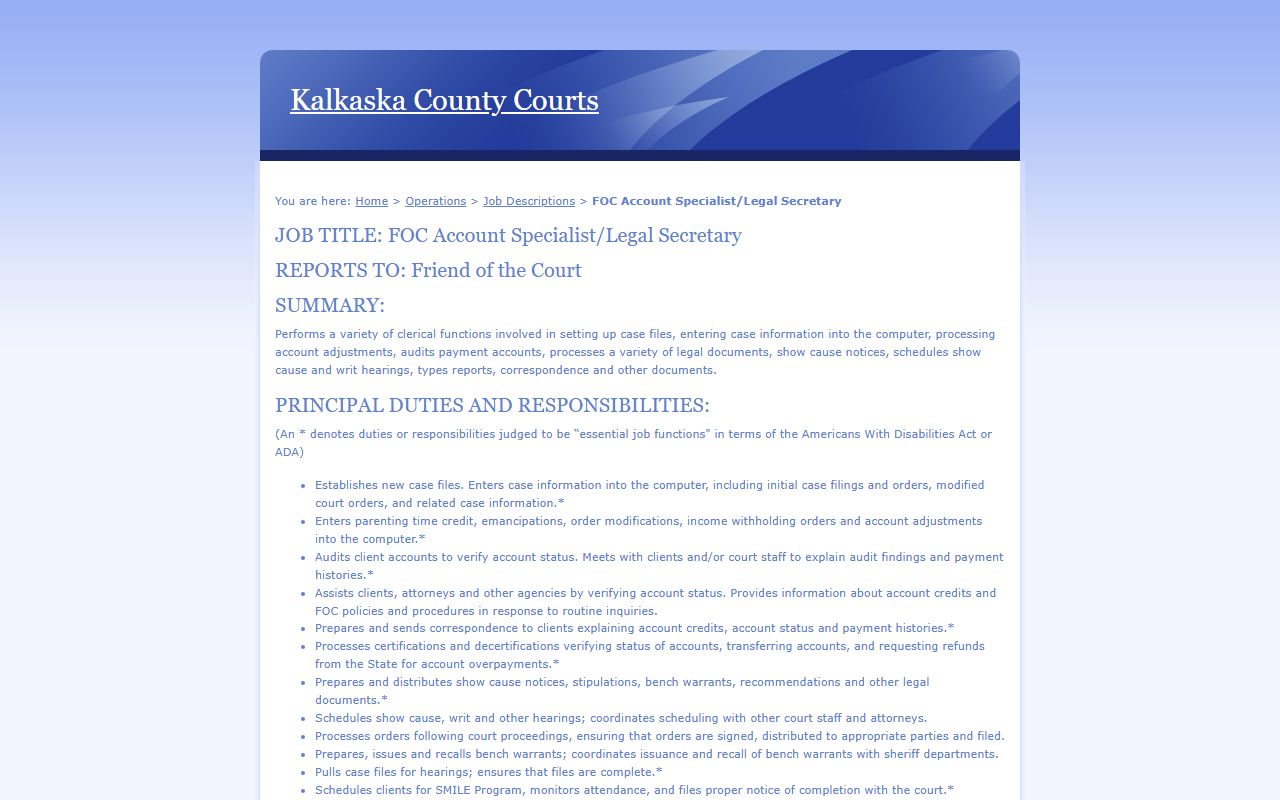
Because the FOC hands its warrant work to the sheriff, a support-related bench warrant is cleared by working with both offices: the FOC that issued it and the deputies who would enforce it. The court's own handbook defines the term plainly, calling a bench warrant a court order to arrest a person and bring that person before the issuing court. That definition matters, because a bench warrant is recalled by the same court that signed it, not by paying a fine at a window.
What a Kalkaska County Warrant Record Shows
A bench-warrant record is a compact document, but every field on it points a reader toward the office that can help. Knowing the fields ahead of a phone call makes the call shorter, because staff ask for the same details the record already carries. The court glossary that defines these terms is published on the Friend of the Court handbook page.
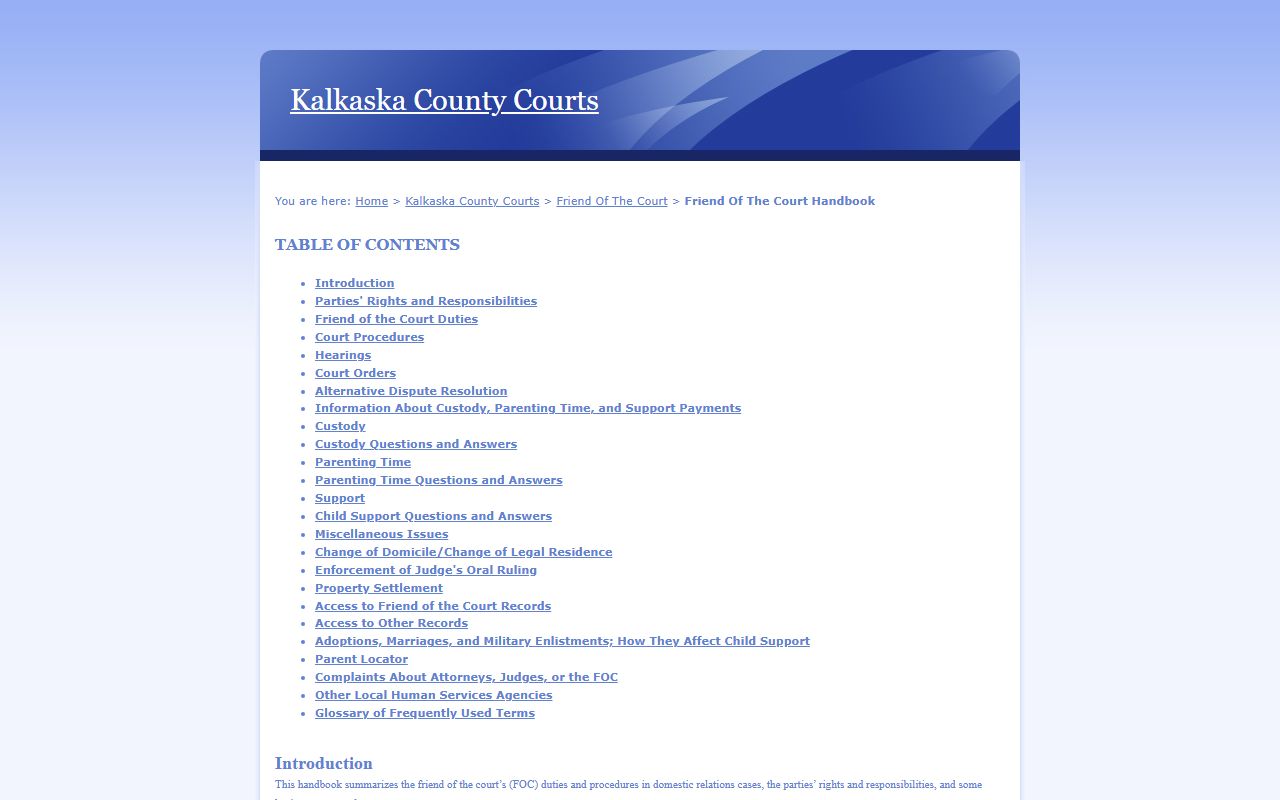
The handbook glossary sits behind the plain-English labels below, which mirror the field types the county's own case and criminal-matters pages display. A sample bench-warrant inventory looks like this.
| Field | What It Shows |
|---|---|
| Issuing court | The division that signed the order, such as the 87-B District Court, circuit, family, or Friend of the Court. |
| Case number | The court file the warrant is attached to, used to pull the underlying matter. |
| Defendant | The named person the court has ordered arrested and brought before it. |
| Warrant type | Arrest, bench, or search, which signals why the order exists. |
| Date issued | When the judge or magistrate signed the warrant. |
| Underlying charge | The offense, missed appearance, or support matter that triggered the order. |
| Bond or bail | The amount set for release, or a note that bail was denied. |
How to Resolve a Kalkaska County Warrant
Clearing a warrant is a sequence, and skipping a step usually costs time. The safest first move is legal advice, because a lawyer can arrange a surrender, argue bond, and sometimes get a bench warrant recalled without a night in custody. From there the path runs through the issuing court and the sheriff.
- Talk to a defense attorney before you contact any office, so you understand the charge and your options.
- Confirm the warrant by calling the Kalkaska County Sheriff's Office at (231) 258-8686 or the court administrator at (231) 258-3330.
- Identify the issuing court, since a bench warrant is recalled only by the division that signed it.
- Ask the court about a motion to quash or recall the warrant, or about setting a new hearing date.
- Arrange bond or a voluntary surrender through counsel, and post any amount the court set.
- Appear at the scheduled hearing, because resolving the case is what finally clears the order.
Important: Speak with a lawyer before you turn yourself in, since counsel can time a surrender, argue for a lower bond, and often keep a short trip from becoming a long one.
Booking and jail contact for a person taken into custody are covered on the county inmate records page, including how Kalkaska routes housing to Wexford County.
Failure to Appear and License Suspension
Missing a court date is the most common way an ordinary case turns into a warrant. The county traffic page states that failure to appear or pay can lead to a default judgment and driver-license suspension, with a 10-day notice period before the suspension path takes effect. A civil infraction that seemed minor can end with a hold on the license and clearance paperwork to fix it.
Criminal matters carry a harder edge. The criminal-matters page says that failure to appear or resolve a criminal case can lead to a warrant and other consequences, and misdemeanor traffic can bring arrest, arraignment, and appointed counsel depending on the jail exposure. The full charge history and sentencing detail behind a warrant live in the county criminal court records.
The lesson is simple. A warrant and a license suspension often ride together, so clearing the court matter is what lifts both.
County Warrants and State Supervision Systems
People often confuse a county warrant with a state record, and the two are not the same. The Michigan Offender Tracking Information System covers people under Department of Corrections supervision or discharged within the last three years, and it does not include county-jail or local warrant data. So OTIS answers a parole or probation question, but it will not tell you whether the Kalkaska courthouse has a bench warrant on file.
The comparison below shows where each kind of record actually lives, and it explains why the sheriff and the issuing court remain the real sources for a local warrant.
| Warrant or Record | Where It Lives | How to Check |
|---|---|---|
| County arrest or bench warrant | Kalkaska County Sheriff and the issuing court | Phone the sheriff or court administrator; file a FOIA request under MCL 15.234 if not posted |
| Support-related bench warrant | Friend of the Court and the sheriff | Contact the FOC that issued it and the deputies who enforce it |
| Parole or probation supervision | Michigan Department of Corrections | OTIS offender lookup |
Note: OTIS excludes county-jail and city-lockup inmates, so a clean OTIS result never proves that a local warrant does not exist.