
What Kalkaska County Probate Covers
Probate in Kalkaska County runs through the Probate Division of the unified 46th Circuit Trial Court, not a separate building of its own. The court's routing pages say probate handles conservatorships, decedent's estates, guardianships, mentally impaired proceedings, and wills and trusts. The probate register receives, reviews, and files legal documents tied to those matters. So the division works as both a filing counter and a procedural gateway for families across the county.
The division does more than open estates. Its duties reach a wide set of civil life events that need a judge's order to move forward.
- Appointing guardians and conservators for minors and adults who cannot manage their own affairs.
- Issuing name-change orders for minors and adults.
- Filing acknowledgments of paternity for children born out of wedlock.
- Settling trust disputes and holding wills for safekeeping.
- Committing mentally ill persons to treatment and emancipating minors.
- Performing secret marriages and ordering treatment for contagious-disease cases.
The court's own probate page, hosted on the 46th Circuit Court site, lays out these duties and the venue rule for each matter. That reference makes clear which filings belong in probate and which route to the family or district divisions instead.
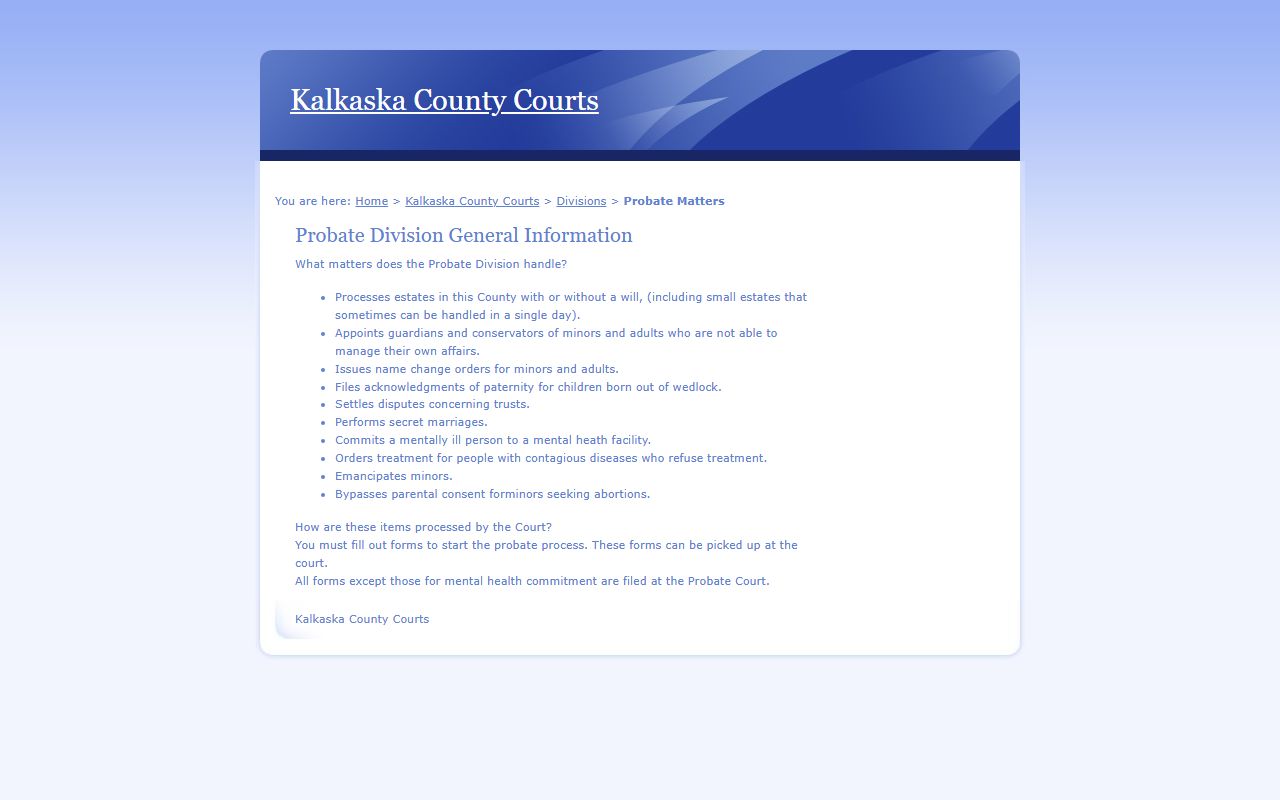
The page confirms probate as the gateway for estates, guardianships, conservatorships, and mental-health commitment in Kalkaska County. It also notes that small estates can sometimes be handled in a single day.
Probate Terms Defined
Probate paperwork leans on a few core words. A quick read of the terms below makes the fee table, the forms, and the court's own notices much easier to follow.
- Testator
- The person who made a will while alive, naming who should receive their property.
- Executor
- The person named in the will to carry out its terms and settle the estate. Michigan often calls this role the personal representative.
- Intestate
- Dying without a valid will, which means state law decides who inherits.
- Guardianship
- A court order that gives one person legal authority over the care of a minor or an adult who cannot make safe decisions.
- Conservatorship
- A court order that puts one person in charge of another's money and property when that person cannot manage it.
Kalkaska County Estate and Will Records
An estate file is the paper trail of how a person's property passes after death. It opens with a petition and, when one exists, the deceased person's will. From there the file grows as the personal representative reports what the estate holds and how it is spent or handed out. The probate division processes estates with or without a will, and it settles trust disputes when heirs disagree.
A typical Kalkaska County probate file can hold several kinds of documents.
- The will, if the person left one, plus any codicils.
- The petition to open the estate and the order appointing a representative.
- Letters of authority that prove the representative can act.
- An inventory listing the estate's assets and their value.
- Accountings that show income, bills, and distributions.
- The final order closing the estate.
Venue drives where the file lives. Decedent's estates go to probate in the county where the person resided or where property is located, and will and trust issues follow the same rule. That is why a Kalkaska resident's estate opens on North Birch Street rather than in the county where an heir happens to live.
Guardianships and Conservatorships
Guardianship and conservatorship both protect someone who cannot fully protect themselves, but they cover different needs. A guardian looks after a person's care and daily welfare. A conservator manages money and property. The probate division appoints both, for minors and for adults, when the court finds that help is needed.
Venue for these cases follows the person, not the paperwork. Guardianships are filed where the person resides or is found, and conservatorships generally go to probate where the person resides or where property sits. These files can stay open for years, since the court keeps watch through reports and reviews until the need ends.
Guardianship and conservatorship are civil probate matters, and they should not be confused with family-law cases like divorce. Marriage licenses and divorce case files are handled separately through the county's marriage and divorce records rather than the probate division.
Mental-Health Proceedings in Probate
Probate also carries the county's most sensitive civil work. The division can commit a mentally ill person to a mental-health facility, and it can order treatment for people with contagious diseases who refuse care. These proceedings sit in probate because they need a judge's finding and close review, not because they are criminal.
Filing rules here differ from the rest of probate. The county's own guidance says forms can be picked up at court, and that all forms except mental-health commitment forms are filed at the probate court. Mental-health commitment paperwork follows its own intake path, so callers should confirm where to submit it before making the trip.
Note: Mental-health commitment records are among the most access-limited probate files, so most of the file is closed to the general public.
How to Open a Kalkaska County Probate File
Opening a probate matter starts at the court, not online. There is no self-service probate database for the county, so the first steps are picking the right venue and the right forms. The probate register reviews and schedules what comes in, which keeps the intake orderly.
- Confirm venue. Estates open where the deceased resided or held property, guardianships where the person resides, and mental-health cases where the person resides.
- Pick up the correct forms at the court. All forms except mental-health commitment forms are filed at the probate court.
- Complete the petition, gather the will or supporting papers, and calculate the filing fee for that action.
- File at the counter during court hours, and pay the fee for the petition type.
- Attend the hearing when one is set. If the court approves, it issues letters of authority or the order requested.
The probate register's job description, posted on the court's staff page, spells out how filings are received, reviewed, and scheduled. It shows the register as the person who keeps estate, guardianship, and commitment paperwork moving.
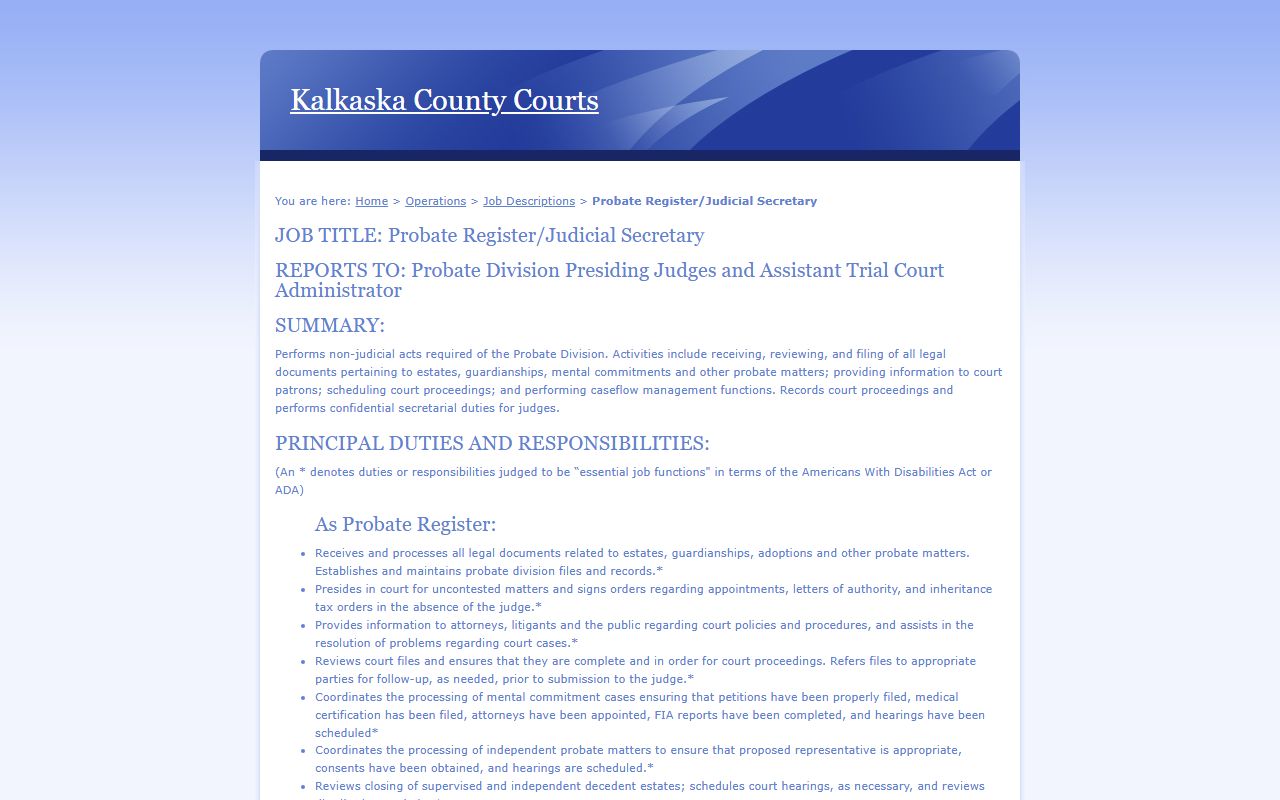
That description underlines a simple point for the public. A real person handles intake, so a phone call before filing can head off missing forms or wrong venue.
Wills Filed for Safekeeping
The probate division will hold a living person's will for safekeeping. This is not the same as opening an estate. It simply places the original will with the court so it can be found and used when the time comes. The service carries a small fee, listed with the rest of the probate schedule below.
Safekeeping helps families avoid a lost or contested original. When the testator dies, the court already has the document on hand, which can speed the estate along. The county notes that some small estates move quickly once the paperwork is in order.
Kalkaska County Probate Filing Fees
Probate fees are set by statewide schedule, so the amounts in Kalkaska County match the Michigan probate fee table. Most new petitions carry a flat filing charge, while smaller motions and objections cost less. The figures below are the common ones a family meets when opening or working a probate matter.
| Item | Amount |
|---|---|
| Petition for probate-related relief | $150 |
| Guardianship petition | $150 |
| Conservatorship or protective-order petition | $150 |
| Petition to reopen a closed file | $150 |
| Will filed for safekeeping | $25 |
| Motion | $20 |
| Objection | $20 |
| Petition for instruction | $20 |
| Petition to open a safe-deposit box | $10 |
The probate inventory fee is separate and is not a flat charge. It rises with the value of the estate, so it must be figured for each case. Michigan posts an inventory-fee calculator that returns the amount once the estate value is entered.
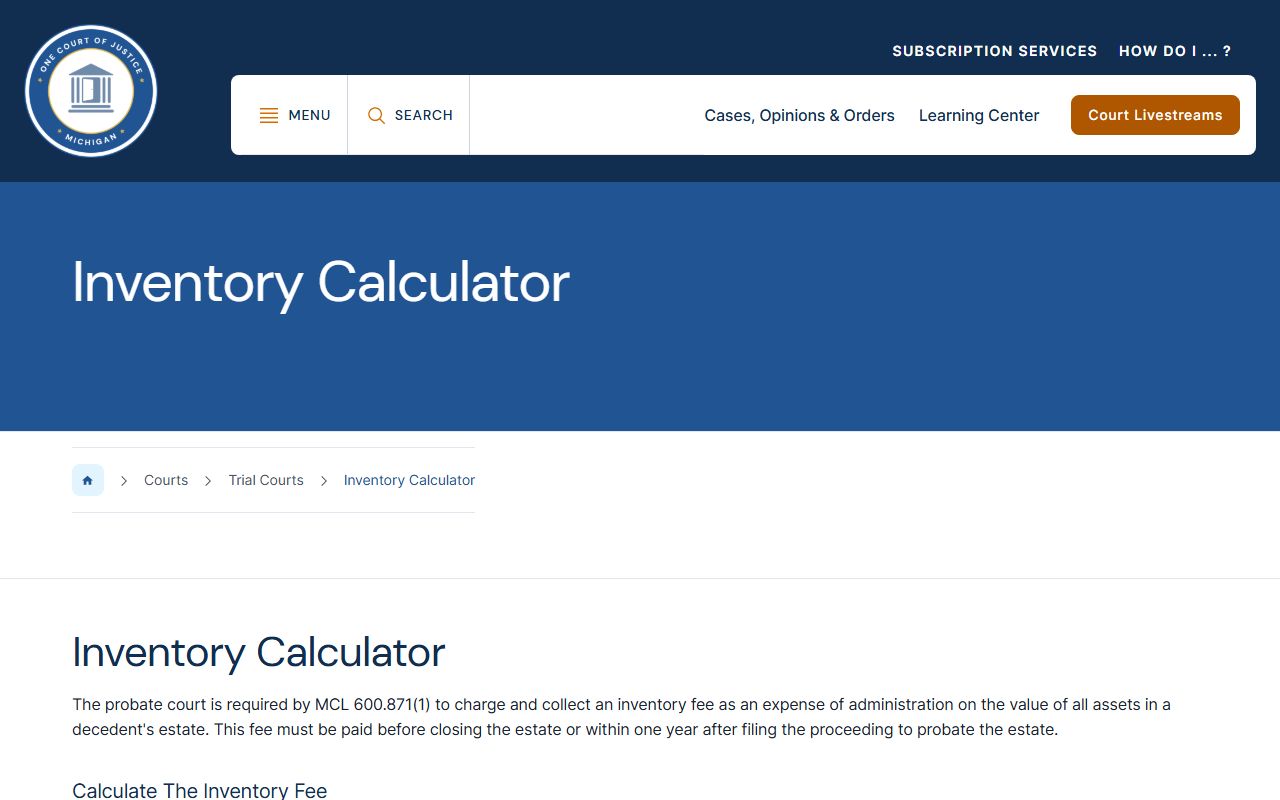
Running the calculator before filing helps a personal representative budget the estate's costs. The tool is the cleanest way to pin down the inventory fee, since the number changes case by case.
The Kalkaska County Probate Division
The probate division shares the county's courthouse campus on North Birch Street with the circuit and district divisions. Hon. Lynne M. Buday serves as the Chief Probate and District Judge. The division keeps its own phone and fax lines, so estate, guardianship, and commitment questions can go straight to probate staff.
Kalkaska County Probate Division
46th Circuit Trial Court
605 North Birch Street
Kalkaska, MI 49646
Phone: (231) 258-3330
Fax: (231) 258-2424
Judge: Hon. Lynne M. Buday, Chief Probate & District Judge
Hours: Mon-Fri, 8:00 a.m. to 4:30 p.m.
An outdoor dropbox at the courthouse takes certain documents outside counter hours. Anything left after 4:00 p.m., or on a day the court is closed, counts as received the next business day.
Access Limits on Kalkaska County Probate Records
Michigan court records are presumed public, but probate holds some of the most protected files in the courthouse. Estate documents are often open, yet mental-health commitment files, minor guardianship details, and sealed matters are not freely browsable. Redactions can also strip Social Security numbers, account numbers, and other private data from files that stay public in part.
The county clerk keeps many other court records, but probate estate and guardianship files stay with the probate division rather than the general Kalkaska County Clerk counter. For a document not posted online, the fallback chain is the same across county offices: ask the division, request it at the counter, or file a public-records request when the file is not otherwise released.
Probate procedure follows its own rulebook. The Michigan Court Rules chapter 5 governs probate practice statewide, from petitions to guardianship reviews. It sets how filings are made and how the court treats sensitive matters.
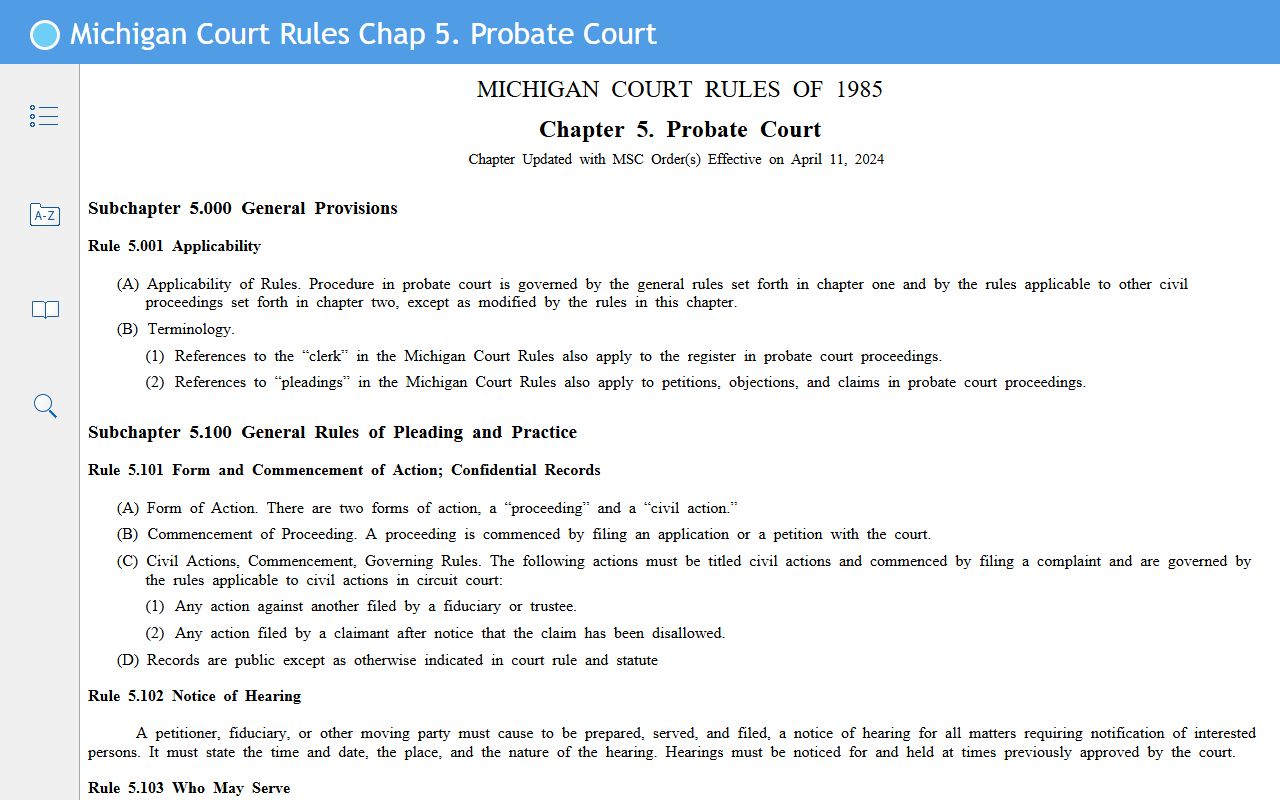
Reading the chapter helps explain why some probate files open freely while others stay closed. The court rules, paired with the state's records-access framework, decide what a member of the public may see.