
How to Search Kalkaska County Traffic Court Records
Kalkaska County runs its public traffic search through the 87-B District Court case and payment portal at the district court case search. The tool is name driven. You type a last name, run the search, and click a case number to see detail or make a payment. It ties back to real case records, not a static index, so it covers open, paid, and closed traffic matters that ran through the district court.
Have a few things ready before you start. The citation number helps you confirm the right case. The full name on the ticket drives the search itself. A date of birth or license number can help sort out common names. Newly written tickets can lag, so a fresh citation may not show up right away.
- Open the district court case and payment portal for Kalkaska County.
- Enter the driver's last name, or a business name for a company ticket.
- Add a first name, or check the broad-match box if you are unsure of the exact spelling.
- Click OK - Display and review the list of names and case numbers.
- Click the case number to see the charge, court date, disposition, and balance, then pay or request a copy.
The county courts page also posts a combined calendar for the circuit, probate, and district divisions. That calendar is informational only. It does not include every proceeding and does not replace the official court file. The traffic ticket instructions page lays out the steps a driver can take after a citation. That page is the best starting point for anyone deciding whether to pay or fight a ticket.
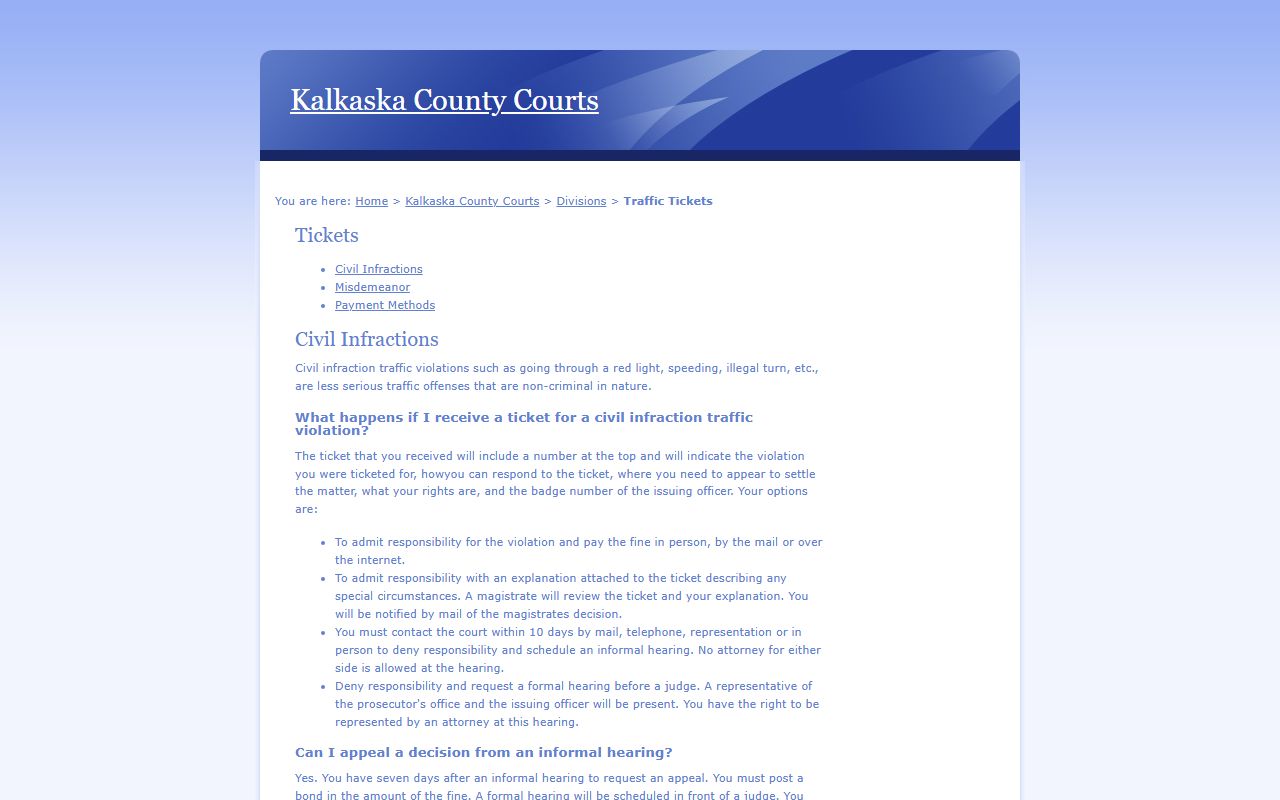
The instructions page spells out the response choices and the deadlines that follow a Kalkaska County traffic ticket. It is the same guidance the district clerk points drivers toward when they call the court.
Which Court Handles Traffic Cases in Kalkaska County
Kalkaska County has no separate municipal or justice court for traffic. The system is unified around the 46th Circuit Trial Court, and traffic matters route to the 87-B District Court. Civil infractions, misdemeanor traffic charges, and parking tickets all begin there. The court sits on the shared courthouse campus in downtown Kalkaska, so the same building holds the district, circuit, probate, and family divisions.
The division that hears a case depends on the charge. A speeding ticket stays in district court. A felony driving offense can begin in district court and move to circuit court after a bindover. A traffic matter involving a driver under 18 may run through the family division instead.
| Court | Traffic Cases Handled | Address |
|---|---|---|
| 87-B District Court | Civil-infraction and misdemeanor traffic tickets, parking, license consequences | 605 N. Birch Street, Kalkaska, MI 49646 |
| Family Division | Juvenile traffic matters for some drivers under 18 | 605 N. Birch Street, Kalkaska, MI 49646 |
| 46th Circuit Court | Felony-level driving offenses after a district bindover | 605 N. Birch Street, Kalkaska, MI 49646 |
The district division phone line is (231) 258-9031. Court offices are open Monday through Friday, 8:00 a.m. to 4:30 p.m.
Civil Infractions and Misdemeanor Traffic in Kalkaska County
Michigan splits traffic offenses into two tracks, and Kalkaska County follows that split. Most tickets are civil infractions. These are not crimes. They are handled through the ticket-response process, and the driver either pays or asks for a hearing. A civil infraction can still add points and affect insurance, but it does not carry jail time on its own.
Misdemeanor traffic is the heavier track. A misdemeanor charge can lead to arrest, an arraignment, and in some cases appointed counsel depending on the jail exposure. Failure to appear on a misdemeanor traffic charge can trigger a warrant and a license suspension. The kinds of matters that show up in the traffic file break down like this.
- Moving violations - speeding, failure to stop, and similar civil infractions written during a stop.
- Non-moving and equipment - registration, equipment, and paperwork infractions.
- Parking tickets - handled through the district court's payment and response process.
- Misdemeanor traffic - charges that can carry arrest, arraignment, and possible jail exposure.
- Juvenile traffic - some matters for drivers under 18 that route through the family division.
Searching Kalkaska County Traffic Records by Citation or Name
The district portal searches by name, not by citation number. That surprises some drivers who expect to type the ticket number. The citation number is still useful once results appear, because it confirms the right case when a name returns several matches. Common last names can produce a long list, so a first name or the broad-match option helps narrow it.
The search form is short. These are the fields the portal shows.
| Search Field | Type | Required | Notes / Format |
|---|---|---|---|
| Last Name/Business | Text | Yes | Search by surname or business name. |
| First | Text | No | Optional field to narrow by first name. |
| Search text contained anywhere in name | Checkbox | No | Broadens the match to any text in the name. |
| OK - Display | Button | Yes | Runs the search. |
| Reset | Button | No | Clears the form. |
Note: Tickets received within the last 5 days may not appear yet, so wait a few days before assuming a citation is missing.
How to Pay or Contest a Kalkaska County Traffic Ticket
A civil infraction gives the driver four choices. You can admit the violation and pay, admit it with an explanation, deny it and ask for an informal hearing, or deny it and ask for a formal hearing. The informal hearing is held before a magistrate and does not allow attorneys. The formal hearing is held before a judge and does allow attorneys. The right choice depends on the ticket and on whether you want legal help.
- Read the citation and the district court traffic instructions to confirm your deadline.
- Decide whether to admit, admit with explanation, or deny the infraction.
- To pay, use the district court portal, pay by credit card at the clerk office, mail a payment, or pay in person.
- If you posted bond, subtract that amount before you pay the balance.
- To contest, request an informal hearing before the magistrate or a formal hearing before the judge.
- Appear on the scheduled date and bring any evidence or witnesses for your hearing.
Do not mail cash. When you mail a payment, include the citation number so the clerk can match it to your case. Missing the citation number can delay credit and leave the ticket open.
What Kalkaska County Traffic Court Records Show
A traffic case file in the district court reads much like any district court record. It ties a driver to a citation, a charge, and a result. The sample district case detail page shows the fields a reader actually sees, from the case number down to the balance due. The record tracks payment as well as the legal outcome.
| Field | What It Shows |
|---|---|
| Case Number | The court's identifier for the traffic case, clickable in the portal. |
| Party Name | The driver or business named on the citation. |
| Charge | The traffic offense as written, listed in the charge table. |
| Court Date | The hearing or response date tied to the citation. |
| Disposition | The result, such as a paid infraction, a plea, or a dismissal. |
| Amount Assessed | The fine and costs charged on the case. |
| Amount Paid / Balance Due | What has been paid and what still remains open. |
Points and license status do not live in this court file. Those sit on the state driving record. The court record is the primary record for the citation itself, while the driving record summarizes the driver's history. For older or non-digitized traffic files, the county Kalkaska County Clerk is the office that pulls and certifies copies.
Failure to Appear on a Kalkaska County Traffic Ticket
Ignoring a ticket does not make it go away. If a driver does not appear or does not pay, the court can enter a default judgment and start the path toward a driver-license suspension. A 10-day notice period applies before that default or suspension moves forward. After the notice period passes, the license can be suspended if the matter is still open.
Watch the 10-day window. Resolving the ticket during the notice period avoids the default judgment and the suspension that can follow. Some clearance paperwork may still be needed until the state system updates.
Misdemeanor traffic raises the stakes. A missed appearance on a misdemeanor charge can bring a bench warrant along with the suspension. If a person is arrested on a misdemeanor traffic matter, they are taken to the county jail and processed for arraignment.
Kalkaska County Court Records vs State Driver Records
These are two different files in two different systems, and mixing them up is the most common traffic-record mistake. The court traffic record is the citation, case number, hearing, plea, and disposition held by the district court. The state driving record is the license-history summary kept by the Michigan Secretary of State. It can show convictions, points, suspensions, and license status.
| Aspect | Court Traffic Record | State Driver Record |
|---|---|---|
| Record source | 87-B District Court, Kalkaska County | Michigan Secretary of State |
| What's in it | Citation, court dates, plea, disposition, fine, warrant actions | License status, convictions, points, suspensions, driver history |
| Where to access | District court traffic portal or the clerk office | Secretary of State driving-record service |
The court record is the one to correct if a citation or disposition looks wrong, because the court entered it. A driving-record error usually traces back to a court disposition that has not yet flowed to the state, so the fix often starts with the court file.
Ordering a Michigan Driving Record
The state driving record comes from the Secretary of State, not the county court. You can order it online, by mail, or in a Secretary of State office. An online order needs a MiLogin account, and records bought online stay visible for 7 days. Every record ordered in a Secretary of State office is a certified record.
You can see the order options on the Michigan driving-record order page.
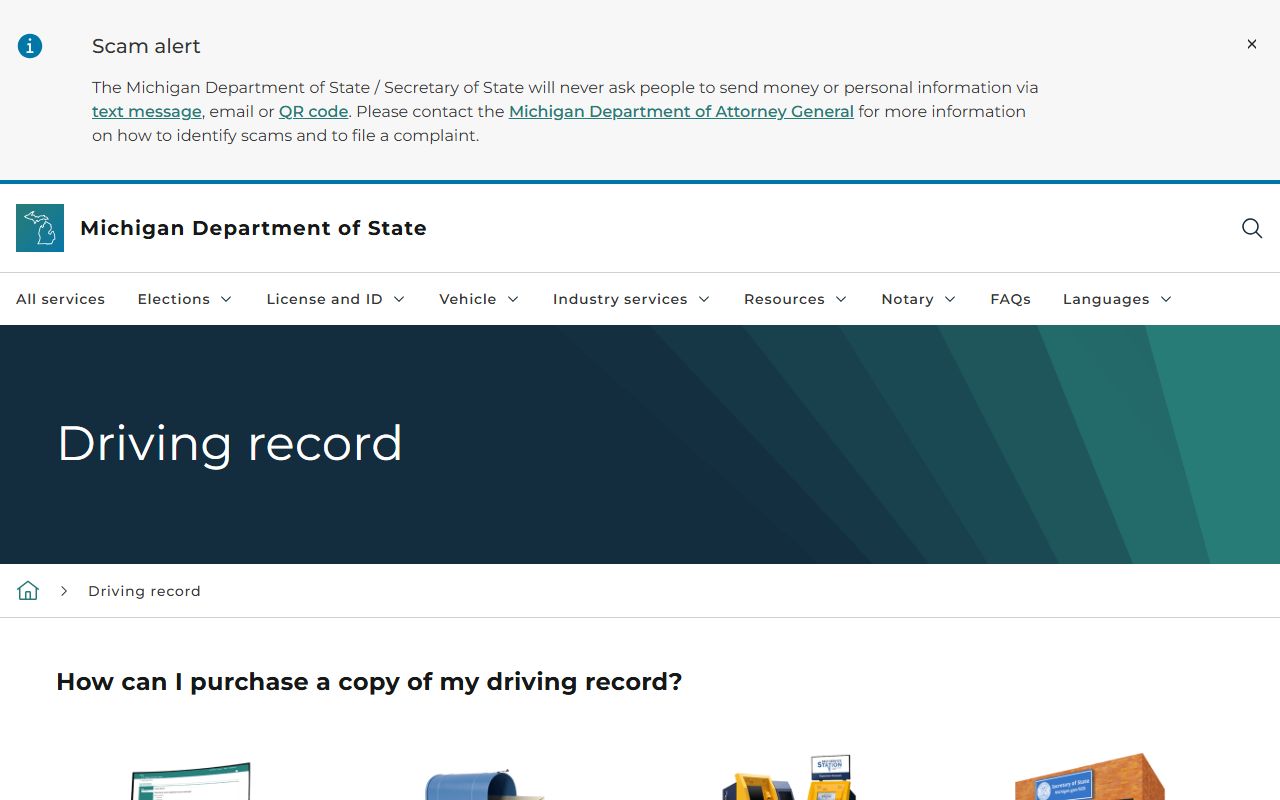
That page routes a driver to the online, mail, and office channels for a Michigan driving record. The fees below apply to the state driving record, not to a district court traffic file.
| Item | Amount |
|---|---|
| Certified driving record online | $16 |
| Driving record by mail | $15 |
| Certified driving record by mail | $16 |
| Online record visibility window | 7 days |
Traffic Points, CDL, and Insurance in Kalkaska County
A traffic ticket can reach past the fine. The county traffic instructions note that points and insurance premiums can be affected by a conviction. Points attach to the state driving record, not to the court file, and they can raise what a driver pays for coverage. That is why the same ticket can feel like two penalties, one from the court and one from the insurer.
Commercial drivers face tougher rules. A commercial driver license carries federal reporting duties, and a violation can hit a CDL harder than a standard license. Drivers who hold a CDL should treat even a minor infraction as a matter worth reviewing, because the license consequence can differ from the court ticket itself.
DUI and OWI Cases in Kalkaska County
Drunk-driving charges are not ordinary traffic infractions. An OWI or DUI charge is a criminal matter, so it does not stay on the civil-infraction track. It runs through arraignment, and a misdemeanor or felony charge can carry jail exposure, probation, and license action. Probation services in the county can require alcohol assessment and screening for these offenses.
For the full case file on an OWI or DUI charge, see the Kalkaska County criminal court records. That page covers arraignment, plea, disposition, and sentencing detail that the traffic portal does not carry.
Public Access to Kalkaska County Traffic Records
Michigan traffic court records are generally public, but access runs through a few gates. The court portal is the convenience tool. The clerk office holds the official file and issues certified copies. A Freedom of Information Act request is the fallback for records that are not posted online. Driving records carry an added privacy layer set by federal law.
Key Statutes:
Michigan FOIA, MCL § 15.231 - sets the public-records framework for records held by public bodies.
Michigan Court Rule 8.119 - makes court records presumptively public, subject to sealing, confidentiality, and access limits.
Driving and vehicle records are also protected under the federal Driver's Privacy Protection Act. The Secretary of State explains those limits on its driver and vehicle records FAQ.
That FAQ shows how the DPPA restricts who can pull personal information from a Michigan driving record, which is why the state file is not as open as the court's public traffic docket.