
What Is a Kalkaska County Court Docket
A docket is the court's dated list of everything that happens in a case. Each line, called a docket entry, marks one event: a filing, a hearing, a bond decision, a plea, or a ruling. Read top to bottom, the docket tells the story of a case from the day it opened to the day it closed. Clerks add each entry as the event occurs, so an active docket grows over time.
The docket is a short index, not the case file. It names the event and the date but does not hold the full text of every motion, order, or exhibit. In Kalkaska County the same docket format runs across the 46th Circuit Court, the 87-B District Court, and the Probate Court, because all three divisions work out of the courthouse on North Birch Street. A felony that starts in district court and moves up to circuit court keeps a docket at each level, so one case can leave more than one trail.
Docket entries lean on a set of short legal terms. The county's own court glossary defines the words that show up most often on a criminal or civil docket.
- Arraignment
- The first court appearance, where a defendant hears the charge and enters a plea.
- Bond
- Money or conditions set to release a defendant while the case is pending.
- Motion
- A written request asking the judge to rule on a specific issue.
- Continuance
- An order moving a hearing to a later date.
- Disposition
- How a charge or case ended, such as dismissed, guilty, or acquitted.
- Order
- A signed direction from the judge that both sides must follow.
- Bench warrant
- A court order to arrest a person and bring them before the judge, often after a missed hearing.
The court publishes this glossary online so the public can decode a docket without a lawyer. You can review the full Kalkaska County court glossary for more terms before you read a case.
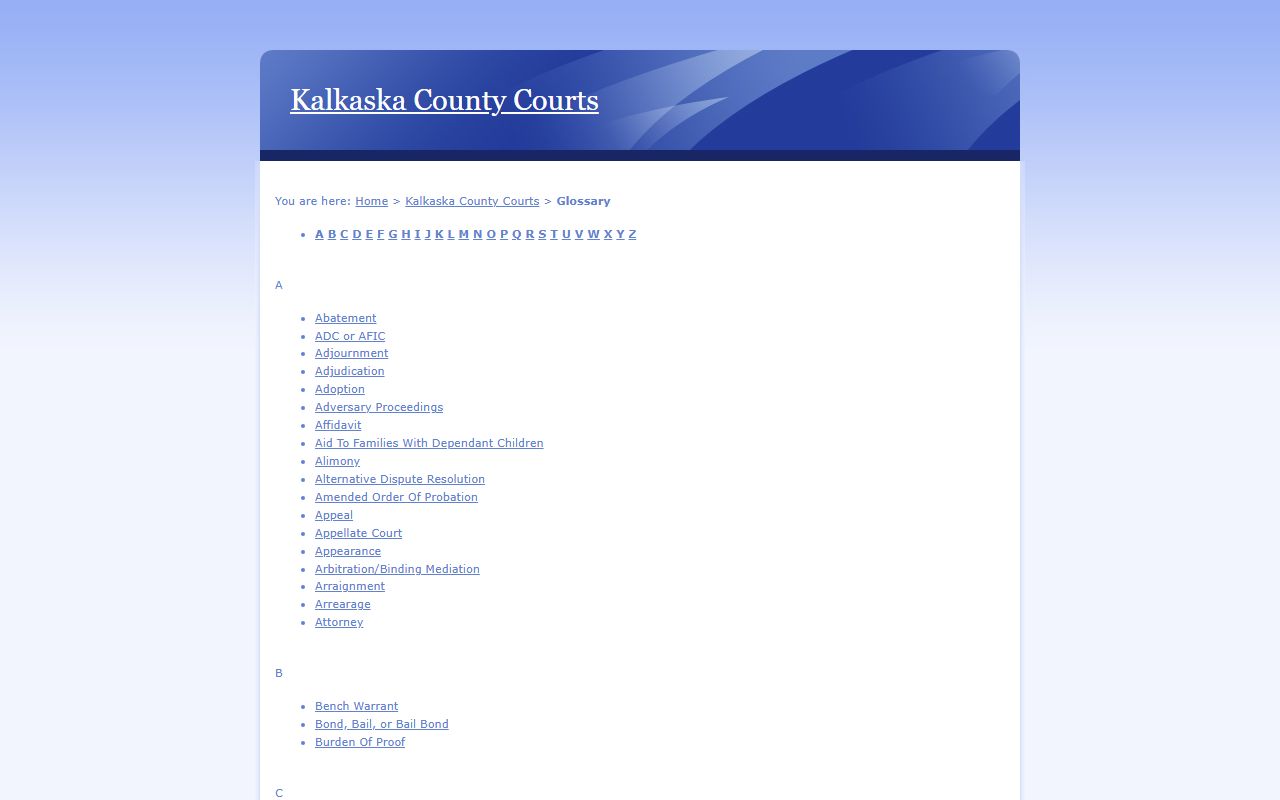
The glossary page spells out docket, disposition, and warrant in plain words, which makes each dated line on a case docket much easier to follow.
The Combined Calendar for Kalkaska County Courts
The county courts page publishes a combined calendar that pulls circuit, probate, and district hearings into one view. It is the main way the public sees upcoming Kalkaska County court dockets without logging into a case system. The calendar lists scheduled proceedings by date so a party, witness, or attorney can plan around a court day.
The calendar carries a clear warning. It is offered for informational purposes only, it does not include all scheduled proceedings, and it does not alter or replace the official court record. In plain terms, a hearing can exist even if the calendar does not show it, and the calendar cannot be used to prove what the court actually did. Treat it as a heads-up, not as proof.
The court also runs a biweekly newsletter that shares court information and scheduling notes with the public. You can view the Kalkaska County court newsletter page to sign up for those updates.
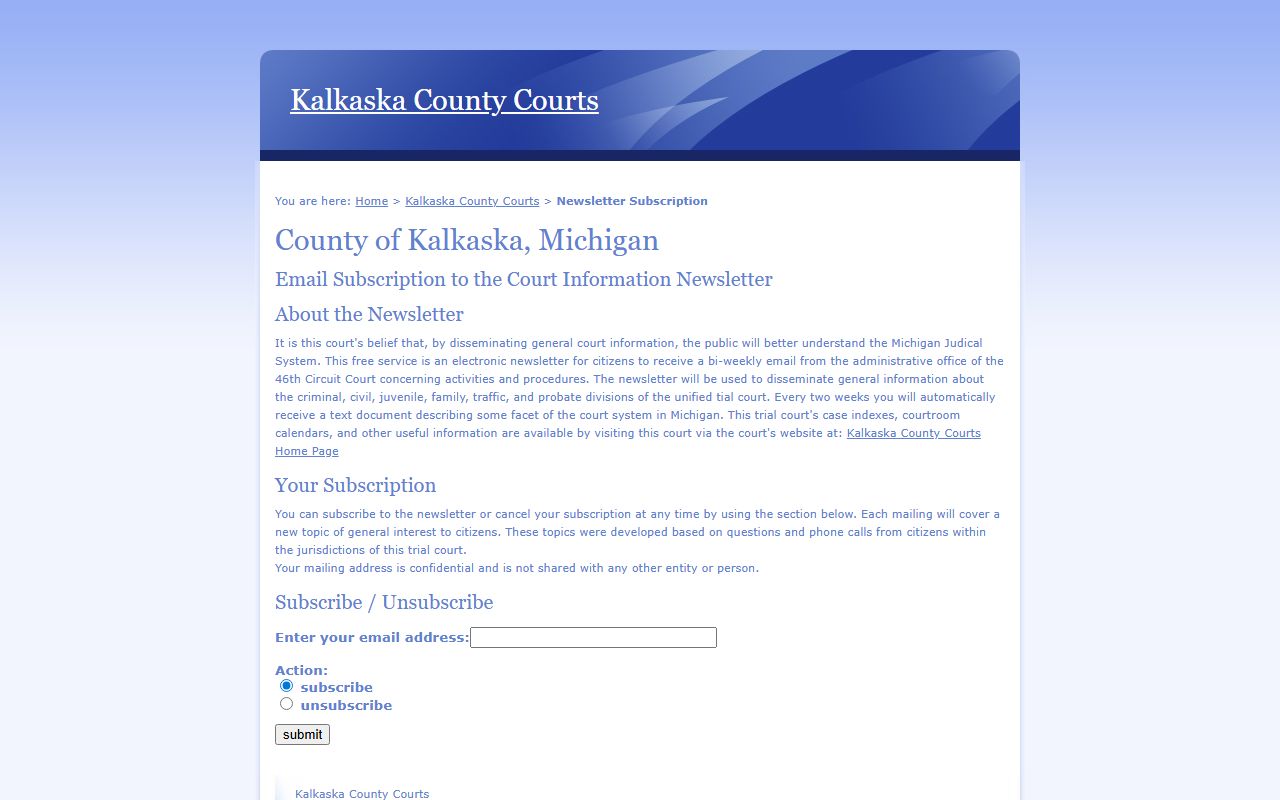
The newsletter sign-up sits alongside the combined calendar as a second channel for court dates, so a reader can track dockets by email as well as on the calendar.
Because the calendar is a convenience tool, it should never be your only source for a court date. Confirm any hearing with the division that handles the case before you rely on it.
How to Check a Kalkaska County Docket Online
For case status and payments, the county points the public to the 87-B District Court case search. It is a free, name-driven tool with no login. You type a name, run the search, and click a case number to open its detail view. The same page handles fine payments, so it doubles as a docket-status and payment channel for district matters.
- Open the 87-B District Court case search from the county courts page.
- Enter a last name or business name. Add a first name to narrow the list, or check the broad-match box if you are unsure of the exact spelling.
- Click OK - Display to run the search and view the name and case-number results.
- Click the case number to open the case detail, where charges, amounts, and status appear.
The portal covers district-court cases, which include misdemeanors, traffic civil infractions, small claims, and the early stages of felonies. It is name-based, so a common name may return several matches. Two rules matter before you trust the numbers. Tickets received in the last five days may not be in the system yet, and any bond already posted should be subtracted before you pay a balance.
Note: The 87-B portal is a district-court tool, so circuit and probate hearing dates are tracked through the combined calendar or the division that holds the case.
Reading a Kalkaska County Docket Entry
Once you open a case, the docket and case detail show the events that shaped it. A criminal or traffic docket tends to follow the same order: a first appearance, a bond decision, a plea, and a final disposition, with any missed-hearing notices flagged along the way. The county's traffic and criminal-matters pages describe the entries that flow into a case, and the sample district case detail shows fields like case number, charge, adjudication date, and judgment.
The table below breaks down the common docket-entry fields on a Kalkaska County case and what each one tells you.
| Field | What It Shows |
|---|---|
| Hearing date | The date of a scheduled court appearance, such as a pretrial or motion hearing. |
| Arraignment date | When the defendant first appeared and entered a plea to the charge. |
| Bond | The amount or conditions set for release while the case is open. |
| Plea | The defendant's response to the charge, such as guilty, not guilty, or no contest. |
| Disposition | How the charge ended, for example dismissed, convicted, or acquitted. |
| Warrant / FTA notice | A flag that a bench warrant issued or that the person failed to appear. |
Read together, these fields let you see where a case stands. An open bond with a future hearing date means the case is still moving. A disposition line means it has closed. A failure-to-appear flag warns that a bench warrant may be active, which can also trigger a driver-license suspension on a traffic case. For the full charging detail and sentence behind these entries, the complete Kalkaska County criminal court records carry the underlying file.
Kalkaska County Docket vs Full Case Record
People often ask for a docket when they really need the full case record, or the other way around. The docket is the index of events. The full record is the stack of documents behind those events, including the complaint, motions, exhibits, and signed orders. Each serves a different job, and knowing the difference tells you where to go.
| Docket | Full Case Record | |
|---|---|---|
| Format | List of dated entries | Full documents and filings |
| Access | Often online and free | May require a clerk visit or fee |
| Use | Track case progress and dates | Legal review, proof, and evidence |
The court staff sees a deeper layer than the public docket shows. District clerks process civil, criminal, and traffic cases and manage the workflow behind each entry, while probate registers and magistrates handle their own filings and schedules. That is why the public docket may list a judge's order or a probation report without holding the full text online.
The court's own staffing and administration pages describe how these roles keep the docket moving. You can see the range of court positions on the Kalkaska County trial-court staffing page.
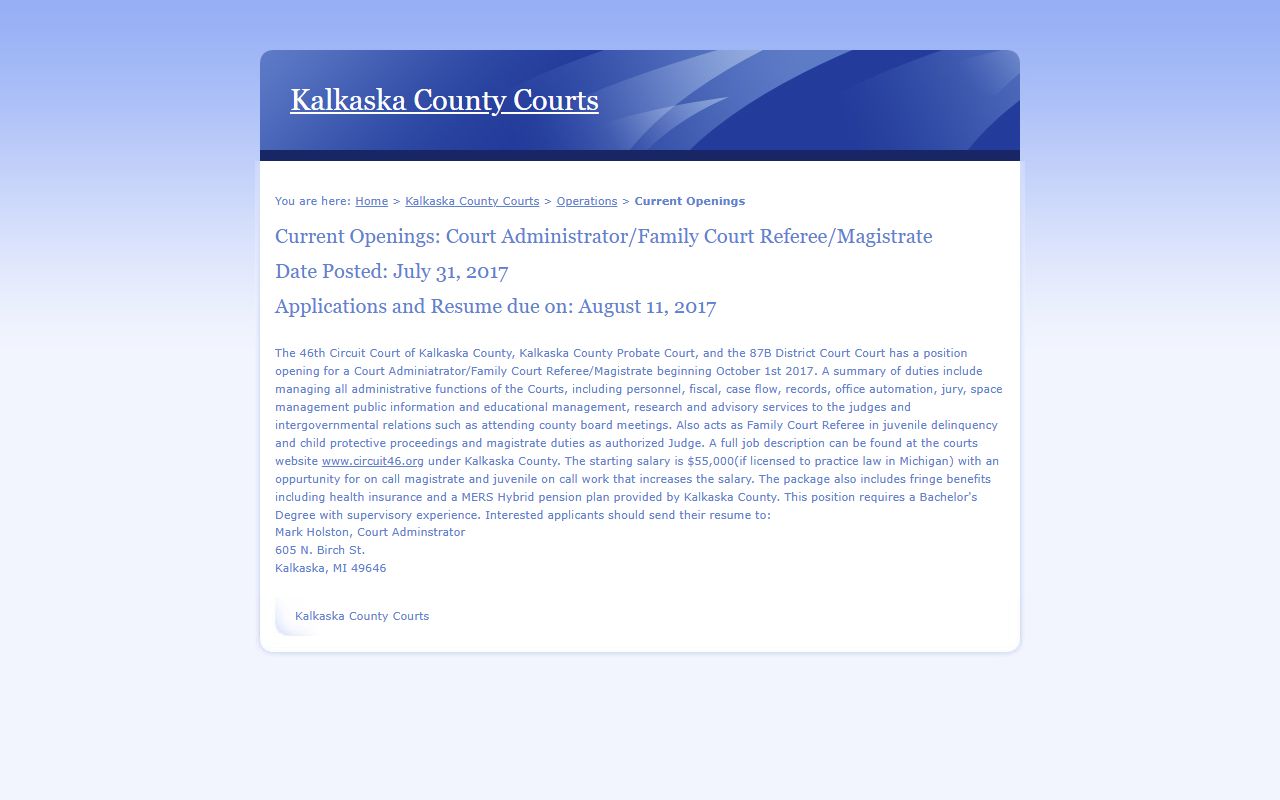
The staffing description shows the clerks and administrators who build and update each docket, which explains why the online list is a summary of a much larger case file. To reach that fuller file, the broader set of Kalkaska County court records and the county clerk are the next stops.
Court Divisions That Publish Kalkaska County Scheduling
The docket you need depends on the division that holds the case. Kalkaska County runs a unified trial court, so felonies and major civil matters sit in circuit court, misdemeanors and traffic sit in district court, and estates and guardianships sit in probate. The family division handles juvenile, divorce, and name-change matters, and the Friend of the Court manages support and parenting-time scheduling. Each division keeps its own calendar and phone line.
When the combined calendar or the online portal falls short, the right move is to call the division directly. The table below lists the court office numbers from the county court contacts page.
| Division / Office | Phone | Handles |
|---|---|---|
| Circuit Court Clerk | (231) 258-3349 | Felony, major civil, and divorce dockets |
| District Division | (231) 258-9031 | Misdemeanor, traffic, and small-claims dockets |
| Probate Division | (231) 258-3330 | Estate, guardianship, and mental-health dockets |
| Family Division | (231) 258-3314 | Juvenile, adoption, and name-change matters |
| Friend of the Court | (231) 258-9744 | Support and parenting-time enforcement |
The county also publishes a routing guide that maps each case type to its division, which helps if you are not sure where a matter belongs. You can check the Kalkaska County court division routing page before you call.
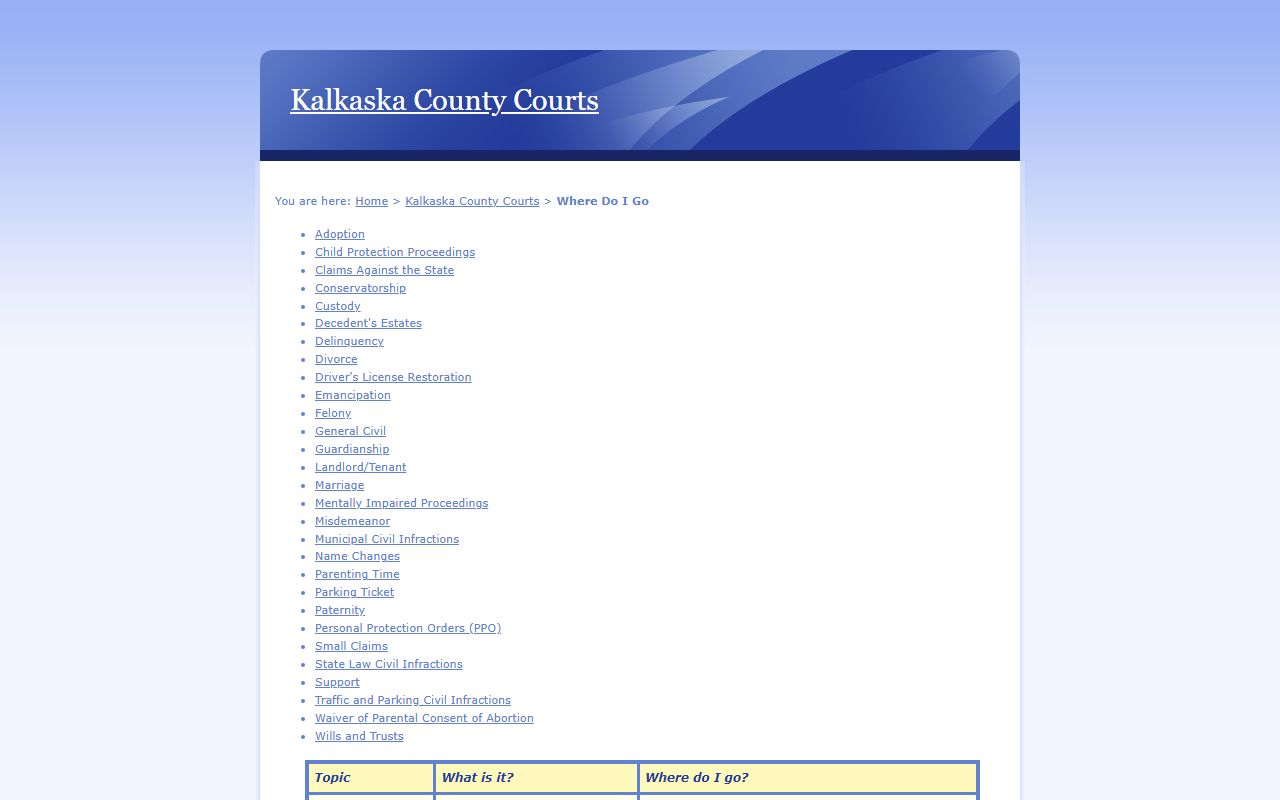
The routing page pairs each matter, from a traffic ticket to a guardianship, with the division that schedules and hears it, so you land on the correct docket the first time.
When a Kalkaska County Docket Is Not Complete
An online docket can lag or leave gaps, so a blank result does not always mean a case does not exist. The 87-B portal warns that tickets received in the last five days may not appear yet, which is the most common reason a fresh case seems to be missing. Give a new matter about a week before you assume it is not on file.
The court also cautions that certain records may be nonpublic and that the public information is offered without any warranty as to accuracy. Juvenile, adoption, mental-health, sealed, and expunged matters are limited by court rule, so they may not surface on a public docket at all. The combined calendar likewise leaves out some proceedings by design. None of these tools is a complete list of every county case.
When the online docket comes up short, the official record still lives with the court. The county clerk, who serves as clerk of the 46th Circuit Court, handles official files, certified copies, and research by mail or in person. Older or non-digitized cases run through that office, and a public-records request under the Michigan Freedom of Information Act is the fallback when a record is not posted online.
Note: The combined calendar and case portal are convenience tools, so the clerk's certified record controls whenever accuracy or a legal filing is on the line.