
How to Search Kalkaska County Court Records
The main public case tool for the county is the 87-B District Court case and payment search at lookup.circuit46.org. The page is simple and name-driven. You type a name, run the search, and click a case number to see detail or make a payment. The 87-B District Court hears misdemeanors, civil infractions, small claims, traffic tickets, and the early stages of felony cases, so this tool covers a wide slice of the county's day-to-day court work.
Before you start, have the party's full name ready. A case number helps if you already have one from a ticket or a notice. Two rules matter up front. Tickets received in the last five days may not appear yet, and if a bond was posted, that amount should be subtracted before you pay. The 46th Circuit Trial Court divisions all share one courthouse, and the court contacts page lists the phone numbers for circuit, district, probate, and family matters when a search does not answer your question.
The county's court division contacts are worth a quick look before you dial. The Kalkaska court contacts lookup page lists the divisions, judges, and direct lines for the courthouse on North Birch Street.
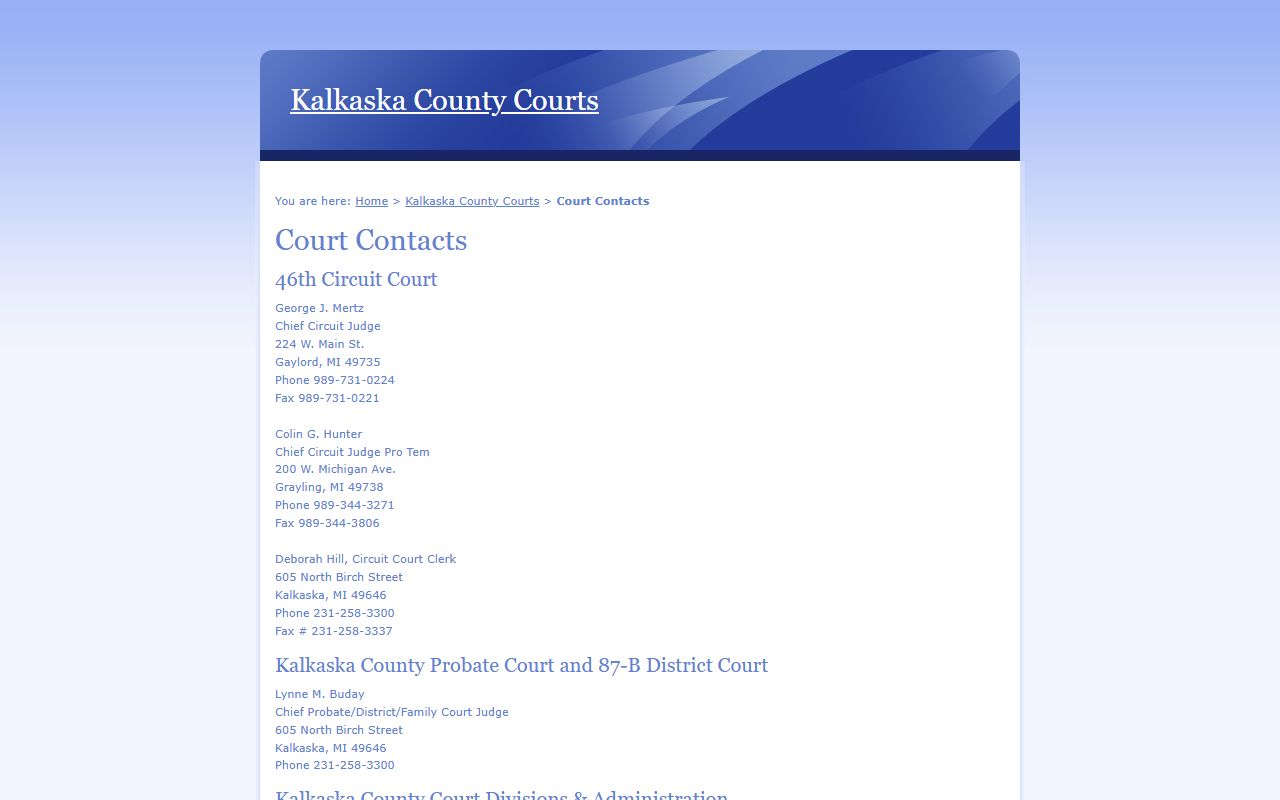
That contact list points you to the right division fast, which matters because the district portal only shows district cases, not the full circuit or probate file.
- Open the 87-B District Court case and payment search, or reach it from the county courts page.
- Enter the last name or business name of the party you are looking up.
- Add a first name if you want to narrow a common surname.
- Check the broad-match box if you are unsure of the exact spelling of the name.
- Click OK - Display to run the search and load the results.
- Review the name and case-number list, then click a case number for detail or payment.
- Remember the five-day lag on new tickets, and subtract any bond already posted before you pay.
Kalkaska County Court Records Search Fields
The district portal keeps its form short, so there are only a few inputs to learn. The search runs on names, not case types, and a business name works the same way a person's surname does. The optional first-name field trims a long result list, and the broad-match checkbox widens the net when a spelling is uncertain. Two buttons control the form itself.
| Field Label | Type | Required | Notes / Format |
|---|---|---|---|
| Last Name/Business | Text | Yes for a useful search | Search by surname or business name. |
| First | Text | No | Narrow the list by first name. |
| Search text contained anywhere in name | Checkbox | No | Broadens the search to any name-text match. |
| OK - Display | Button | Yes | Runs the search. |
| Reset | Button | No | Clears the form. |
Result columns show the party NAME and the CASE #, and the case number is a live link. Click it and the system loads the full case detail, including any balance owed. For traffic matters and ticket payments, the same portal doubles as the pay window, so a citation number pulls up the balance and routes the payment in one step.
Court Calendars and Case Search Tools
The county publishes two separate public tools, and it helps to keep them apart. One is the district case-search and payment portal above. The other is a combined calendar for the circuit, probate, and district courts that lists upcoming hearing dates in one place. The calendar answers a different question. It tells you when a matter is set, not what a file contains.
Read the calendar as a heads-up, not a record. The county states plainly that the combined calendar is for informational purposes only, does not include every scheduled proceeding, and does not alter or replace the official court record. The same caution applies to the case-search portal, which the court offers without warranty as to accuracy. For a fuller look at hearing schedules and how they are posted, the Kalkaska County court dockets page breaks down what the calendar does and does not show.
Michigan also runs a statewide case-search site, MiCOURT, at micourt.courts.michigan.gov. Coverage varies by court and by county, so treat it as a second option rather than a guaranteed hit for every Kalkaska case.
Types of Kalkaska County Court Records
The county's record landscape is easiest to picture by division. Each division of the 46th Circuit Trial Court produces its own class of files, and a single dispute can touch more than one. A divorce with minor children, for example, opens a circuit case and pulls in Friend of the Court support and parenting-time records at the same time.
Court records in the county fall into a handful of broad groups. The district portal shows many of them, while older or division-specific files often sit with the clerk or the relevant court office.
- Criminal records: misdemeanors in district court, plus felonies that begin in district court and move to circuit after a bindover.
- Civil records: general civil matters, money judgments, small claims, and higher-value suits in circuit court.
- Family records: divorce, custody, parenting time, paternity, juvenile, and adoption matters.
- Probate records: estates, wills, trusts, guardianships, conservatorships, and mental-health proceedings.
- Traffic records: civil infractions, misdemeanor traffic tickets, and parking citations.
Juvenile and adoption files sit apart from the rest because they are far more restricted. Personal protection orders are filed with the county clerk, while name changes run through the family division. The full criminal case file holds the charges, pleas, disposition, and sentence for a given defendant.
What Kalkaska County Court Records Show
A district case-detail page packs a lot into one screen. The sample record for the 87-B court displays a case number, the named party, the amount assessed, the amount paid, the balance due, the last payment, a comment line, jail and probation terms, and a charge table. That charge table lists each count, the charge itself, the adjudication date, and the judgment. One sample charge read Domestic Violence, adjudicated June 7, 2023, with a judgment of Dismissed.
You can see the layout of a real case-detail page on the court's own site. The sample district court case detail page shows how the fields stack together for a single case.
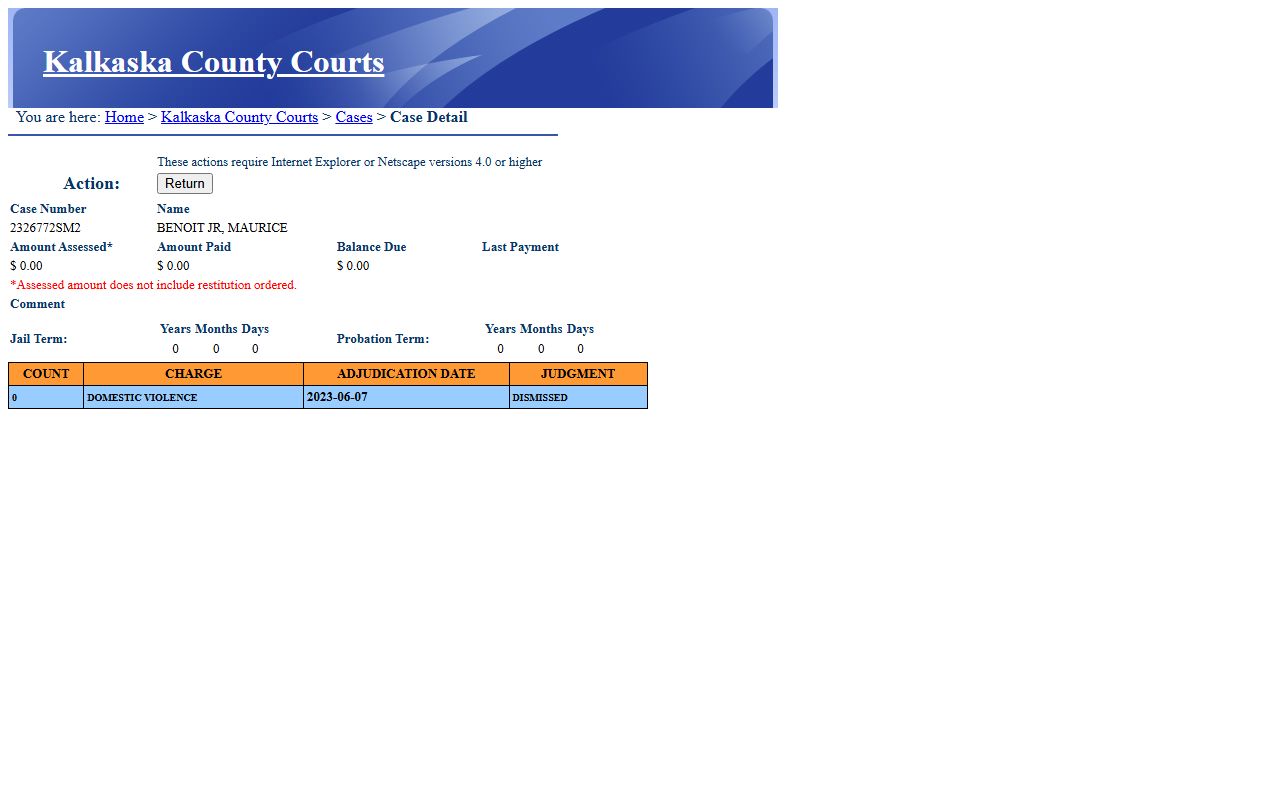
Reading that page top to bottom shows why the portal is useful for both case lookup and payment. The table below breaks down the core fields and what each one tells you.
| Field | What It Shows |
|---|---|
| Case Number | The unique case identifier, such as 2326772SM2, used to pull the file and route a payment. |
| Party Name | The named defendant or business tied to the case. |
| Amount Assessed | Total fines, costs, and fees ordered. A case note flags that this figure does not include restitution. |
| Amount Paid | The running total already paid toward the case. |
| Balance Due | What remains owed after payments post. |
| Jail Term | Any jail sentence stated in years, months, and days. |
| Probation Term | The length of probation ordered, in years, months, and days. |
| Charge / Adjudication / Judgment | Each count, the charge, the adjudication date, and the judgment, such as Dismissed or a plea. |
Case-number formats are not uniform across systems. The district page uses a style like 2326772SM2, while state records for the same person may carry a format like 2002-2197-FH. Do not assume one pattern fits every record type.
Public Access Framework for Kalkaska County Court Records
Michigan court records are presumptively public, but access runs through rules and statutes that set what can be withheld. The core court rule is MCR 8.119, which treats court records as open by default while allowing confidentiality, sealing, and access limits in defined cases. On top of that sits the Michigan Freedom of Information Act, starting at MCL 15.231, which frames the public's right to records held by public bodies.
The state's records-management page lays out how trial courts handle public access and the limits that apply to it. That guidance shapes what a counter clerk can hand over on the spot.
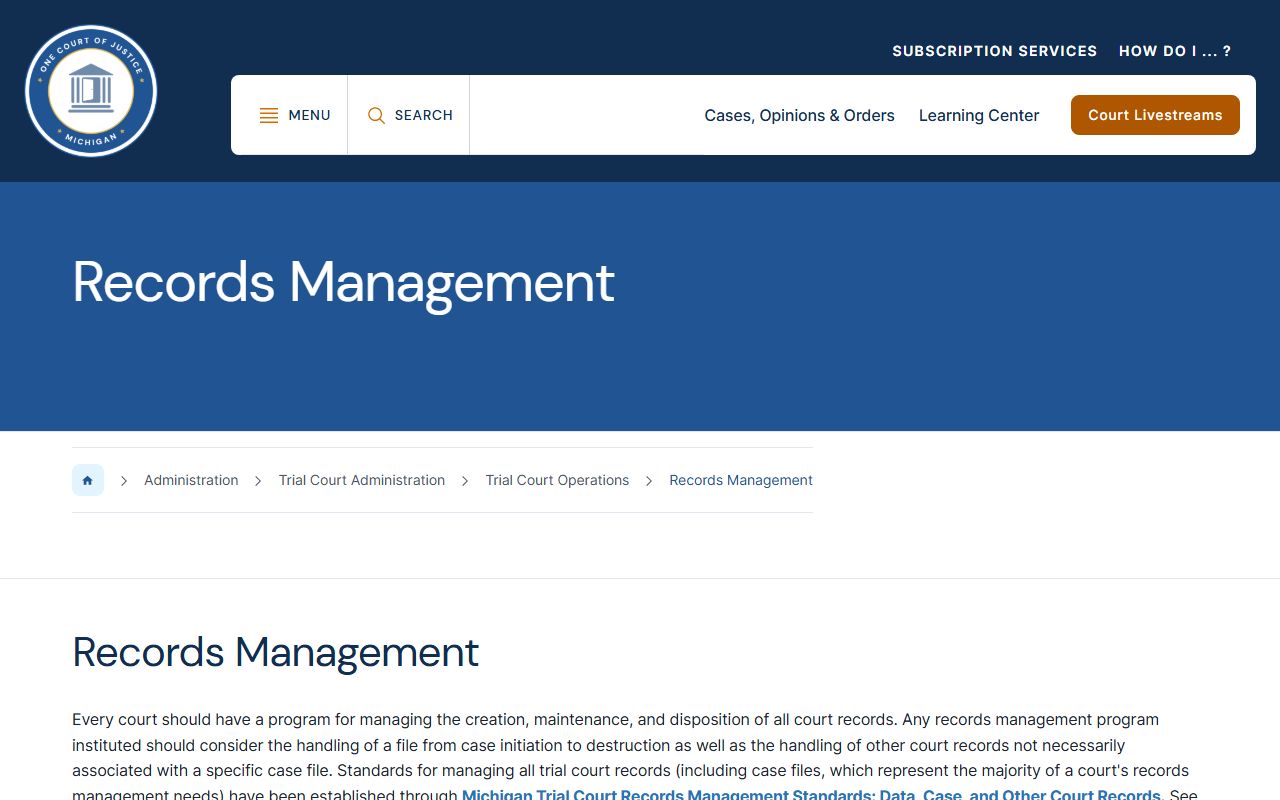
In plain terms, a Kalkaska County court record sits behind one of three gates: the online portal for convenience, the clerk for official files and certified copies, and a FOIA request for anything not posted online. The court rule itself is worth reviewing when a request is denied or delayed.
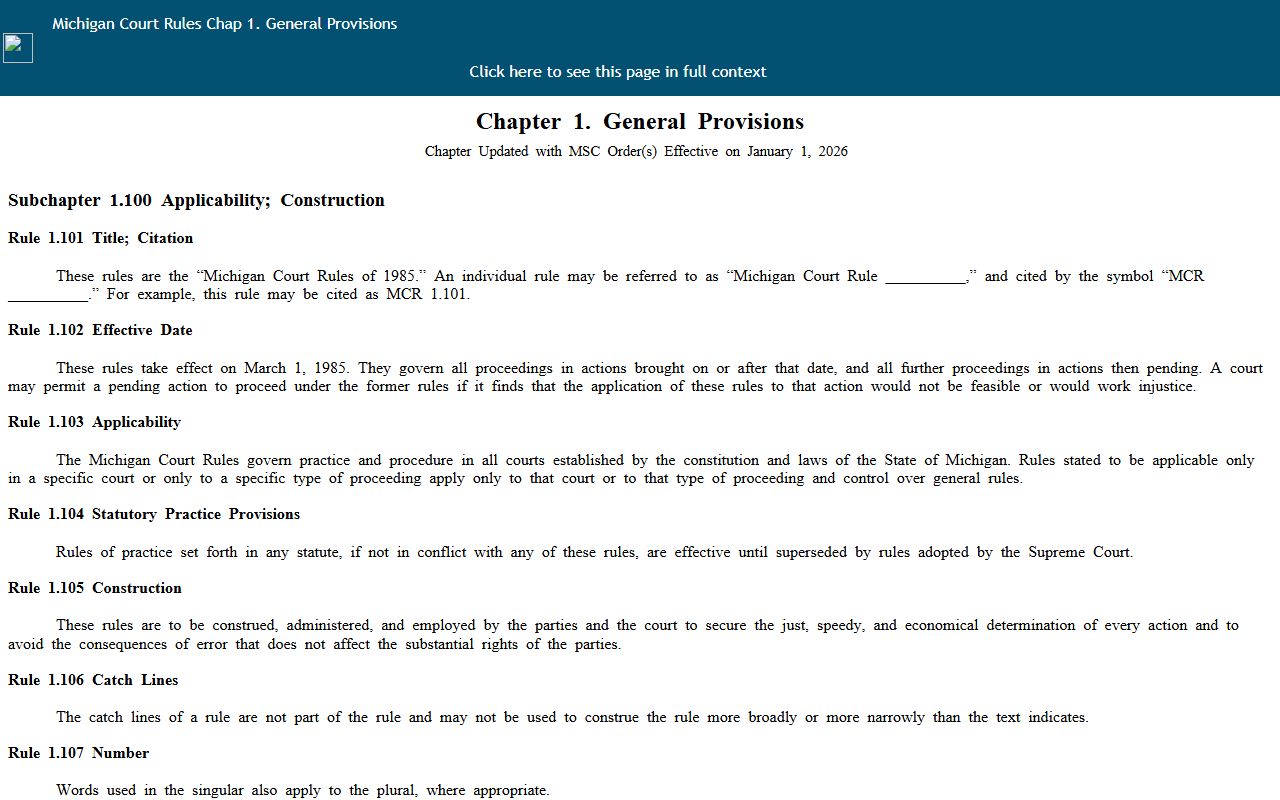
Reading that rule, published in Michigan Court Rules chapter 1, shows exactly which parts of a file stay open and which can be closed.
Note: The county states its case search and combined calendar are informational only and do not replace the official court record kept by the court.
Records That Are Sealed or Confidential in Kalkaska County
Some files are closed or only partly open. In Michigan, the restricted categories are fairly consistent, and Kalkaska County routes them to specific divisions. Juvenile delinquency and child-protection files are not broad public records. Adoption matters run through the family division and stay confidential. Mental-health commitment cases live in the probate division and can be access-limited. Sealed and expunged records drop out of ordinary public view entirely.
Even an open file can carry redactions. Courts remove minors' details, Social Security numbers, account numbers, and similar personal data before releasing a public copy. Expungement, also called a set-aside, removes the practical public visibility of many criminal convictions. The state now runs an automatic Clean Slate process alongside the older petition path.
If you believe a record should be released, or you want a conviction set aside, the process runs through the court, not the online portal. You confirm eligibility, check any waiting period, gather the old case number, file a petition in the proper court, pay the fee unless it is waived, and attend a hearing if one is set. The county does not publish its own expungement page, so the state Attorney General expungement resources and the Michigan set-aside statutes carry the detail.
Requesting Older Records From the Kalkaska County Clerk
The online portal is a convenience tool, not the whole archive. The official record still lives with the court, and older or non-digitized files sit with the county clerk. Records housed in the clerk's office reach back to the year 1871, which makes the office the right first stop for historical case files, certified copies, and genealogy research. The clerk serves as clerk for the 46th Circuit Court, so the counter handles circuit filings along with its many other county duties.
Research can be done by mail or in person, and staff handle older books with care because of their age. The clerk's office is a repository, not just a filing counter, so a call ahead helps for genealogy or older-file requests. For certified copies used in legal proceedings, the clerk is the office to reach, and the Kalkaska County Clerk of Court page covers request methods and fees in more detail.
Kalkaska County Clerk
605 N. Birch Street
Kalkaska, MI 49646
(231) 258-3349
Monday to Friday, 8:00 a.m. to 5:00 p.m.
The courthouse itself keeps slightly different hours, open Monday through Friday from 8:00 a.m. to 4:30 p.m., with an outdoor dropbox for certain transactions. Documents dropped after 4:00 p.m., or on a day the court is closed, count as received the next business day.
Filing a FOIA Request for Court Records
When a record is not posted online and the clerk cannot release it at the counter, the Michigan Freedom of Information Act is the fallback. The county maintains a FOIA page that points to a public summary of its procedures and to the instructions and forms for a Kalkaska County request. The clerk's office processes these requests along with its court-clerk role.
The statute sets the ground rules for the whole process. Section 1 of the act establishes the public's right of access, and the sections that follow govern the timeline, the fees, and the path when a request is refused.
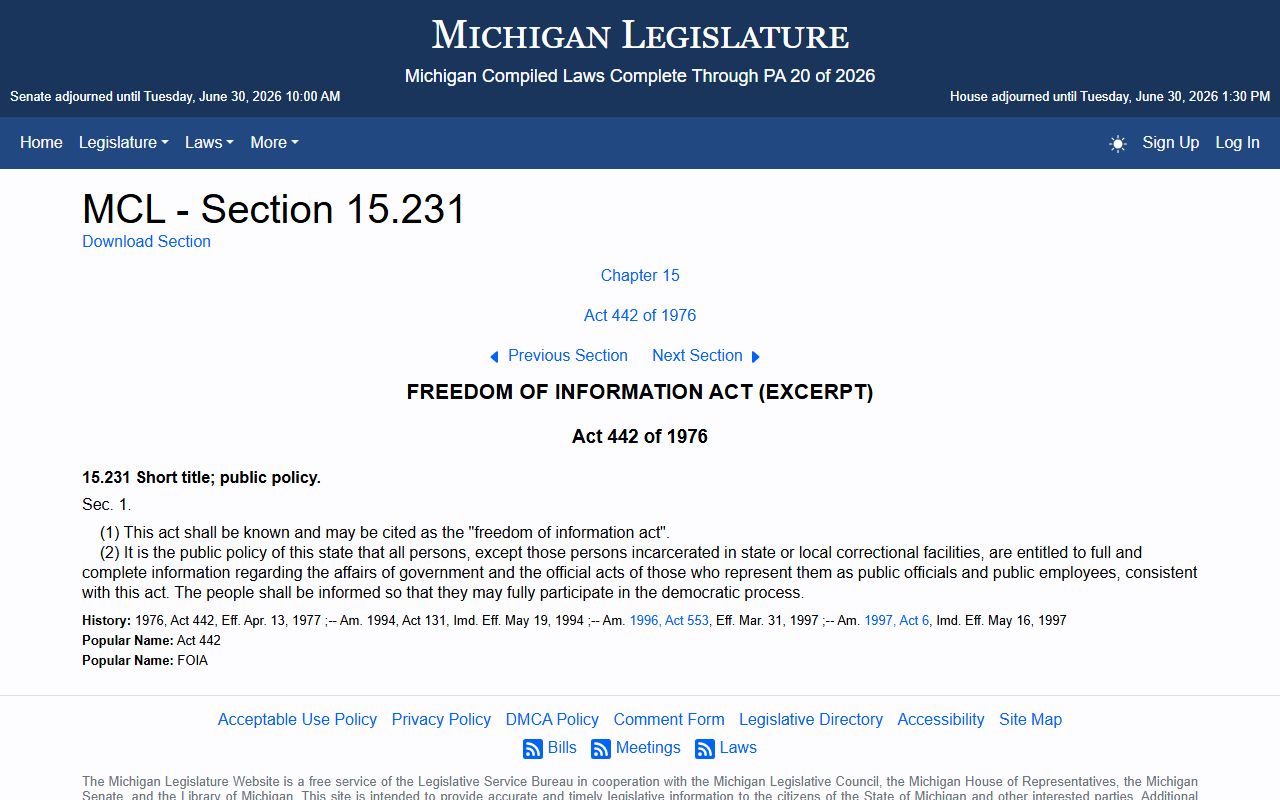
That opening section frames why a public body must answer at all. Under MCL 15.233, the office must respond within the statutory window and may grant, deny, or partly disclose a record. Fees for search, labor, and copies are capped by MCL 15.234, and a denial or an excessive-fee decision can be appealed under MCL 15.235.
Not everything is releasable, and the exemption list explains why some requests come back redacted or denied.
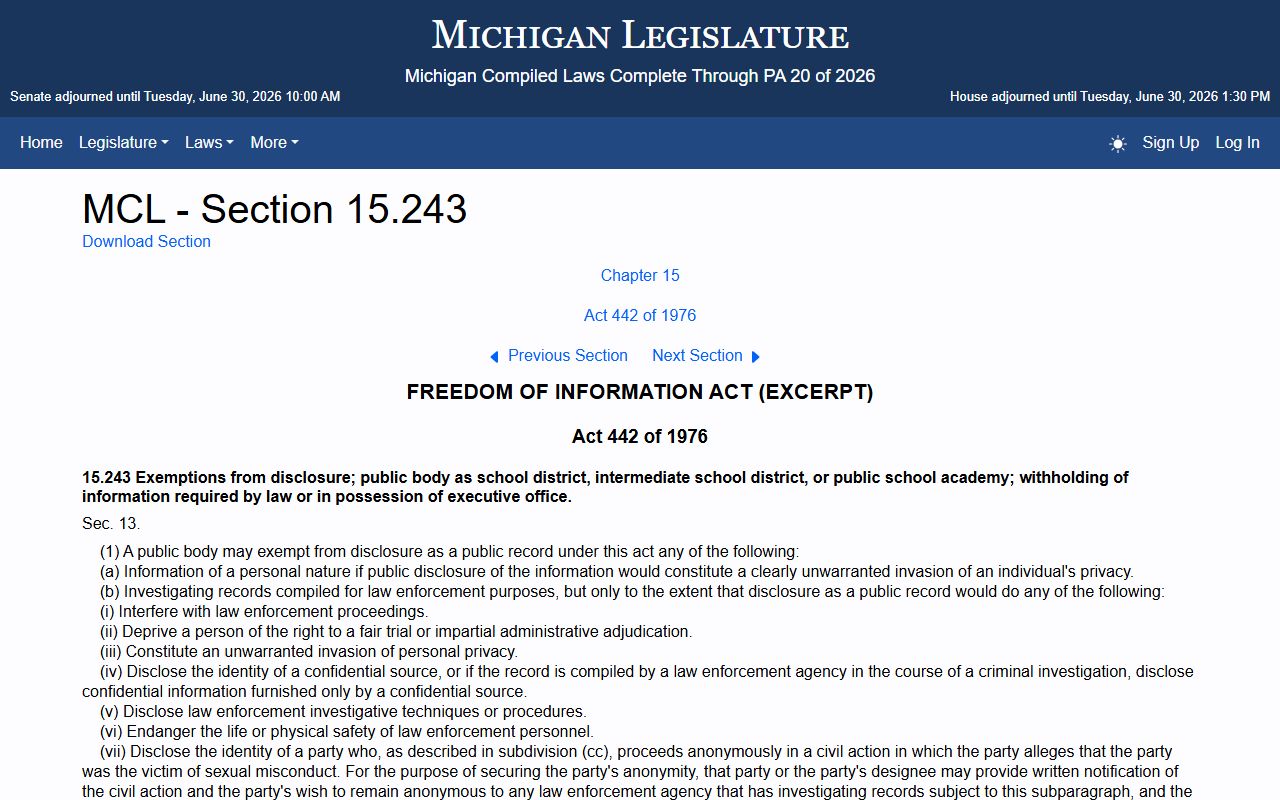
Reviewing the exemptions in MCL 15.243 before you file helps you frame a request that the office can actually fill, and shows in advance which categories a court is likely to withhold.